

Dear Founders, Investors, and Friends,
It’s great to have you back for the January 2026 edition of Blockwall Insights. Here’s what we’re covering today:
The CLARITY Act: Crypto vs. Banks in the Battle for Market Structure
WalletConnect Pay: The Crypto-Native Alternative to Visa and Mastercard
Bitwise Brings Institutional Asset Management Onchain
Gold and Silver Rallies Drive Surge in Onchain Derivatives Trading
Blockwall Portfolio Update
Key Events of the Last Weeks
What We’ve Been Reading
Executive Summary
January delivered one of the most politically charged months in crypto history. The CLARITY Act, the long-awaited market structure bill that would finally give the U.S. crypto industry regulatory clarity, hit a wall after Coinbase CEO Brian Armstrong publicly withdrew support, arguing the current draft would be “materially worse than the status quo.” Behind the scenes, tensions between the crypto industry and traditional banks reached a boiling point at Davos, where JPMorgan’s Jamie Dimon bluntly told Armstrong he was “full of s***” during a chance encounter. The confrontation laid bare the fundamental conflict at the heart of this debate: who will control the future of deposits and payments in America.
Meanwhile, infrastructure for crypto-native payments advanced. WalletConnect rolled out WalletConnect Pay, a system that allows consumers to pay merchants directly from their wallets, bypassing Visa and Mastercard entirely. With live deployments already underway and partnerships with payment terminal provider Ingenico, the service offers a glimpse of what payments could look like when they move fully onto blockchain rails, with fees up to five times lower than traditional card transactions.
In asset management, Bitwise took a significant step by announcing its first blockchain-based investment product. The offering targets 6% APY on stablecoins while allowing users to retain full custody of their assets. It marks a new era for institutional participation in DeFi, one where professional risk management meets transparent, permissionless infrastructure.
Finally, blockchain-based commodity derivatives experienced a breakout month as gold and silver rallies drove record trading volumes to decentralized trading platforms like Hyperliquid. This growth really showed why 24/7, global, and premissionless markets matter.
The CLARITY Act: Crypto vs. Banks in the Battle for Market Structure
The CLARITY Act, the long-awaited U.S. market structure bill, hit a wall last month. First a quick reminder on why its important and how the process looks like.
CLARITY offers long-awaited legal certainty by defining key terms around digital assets and DeFi and dividing oversight between the SEC and CFTC. Crucially, by anchoring definitions into law, the bill would significantly reduce sensitivity to shifts in U.S. administrations’ approach to digital assets.
The legislation requires action from both the U.S. Senate Banking Committee (which oversees the SEC and securities) and the Senate Agriculture Committee (which oversees the CFTC and commodities). Because of their separate jurisdictions, each committee drafts and marks up its own bill text. Once both are finalized, the texts are merged and the full Senate votes on the combined legislation.
Two weeks back, Coinbase CEO Brian Armstrong publicly raised concerns about the current draft by the Banking Committee, arguing it would be worse than having no bill at all. Among his main issues: the bill would effectively ban tokenized equities, restrict DeFi, and eliminate stablecoin rewards in ways that could let banks shut out crypto competition. In response, the Senate Banking Committee postponed its markup vote on the bill indefinitely.
Arguably, stablecoin rewards are the main problem here. Officially, banks fear that stablecoin yield might lure deposits away from community banks, creating bigger risks in the case of bank runs but also limiting access to liquidity for credit. From the crypto industry’s perspective, this rather seems like an attempt to defend bank’s regulatory moat, making it way harder for crypto companies to compete for client deposits.
What makes this whole situation so charged became clear in Davos. During the World Economic Forum, JPMorgan’s Jamie Dimon reportedly told Armstrong he was full of s***, just after Armstrong had publicly accused banks of obstructing crypto-friendly legislation. The confrontation shows just how intense the behind-the-scenes battle between banks and the crypto industry has become.
Now, when it comes to CLARITY, The legislative path isn’t entirely closed, though. Last week, the CFTC’s portion of the bill advanced out of the Agriculture Committee on a narrow 12-11 party-line vote, with no Democrats supporting it. But for the full bill to reach a Senate floor vote, the Banking Committee still needs to agree on its draft and reconcile it with the Agriculture Committee’s version.
As of now, its really difficult to asses which side has the bigger lobbying power and political leverage in Washington to push through with its agenda. Or whether an compromise can be reached.
We remain optimistic and keep a close eye on the negotiations.
WalletConnect Pay: The Crypto-Native Alternative to Visa and Mastercard
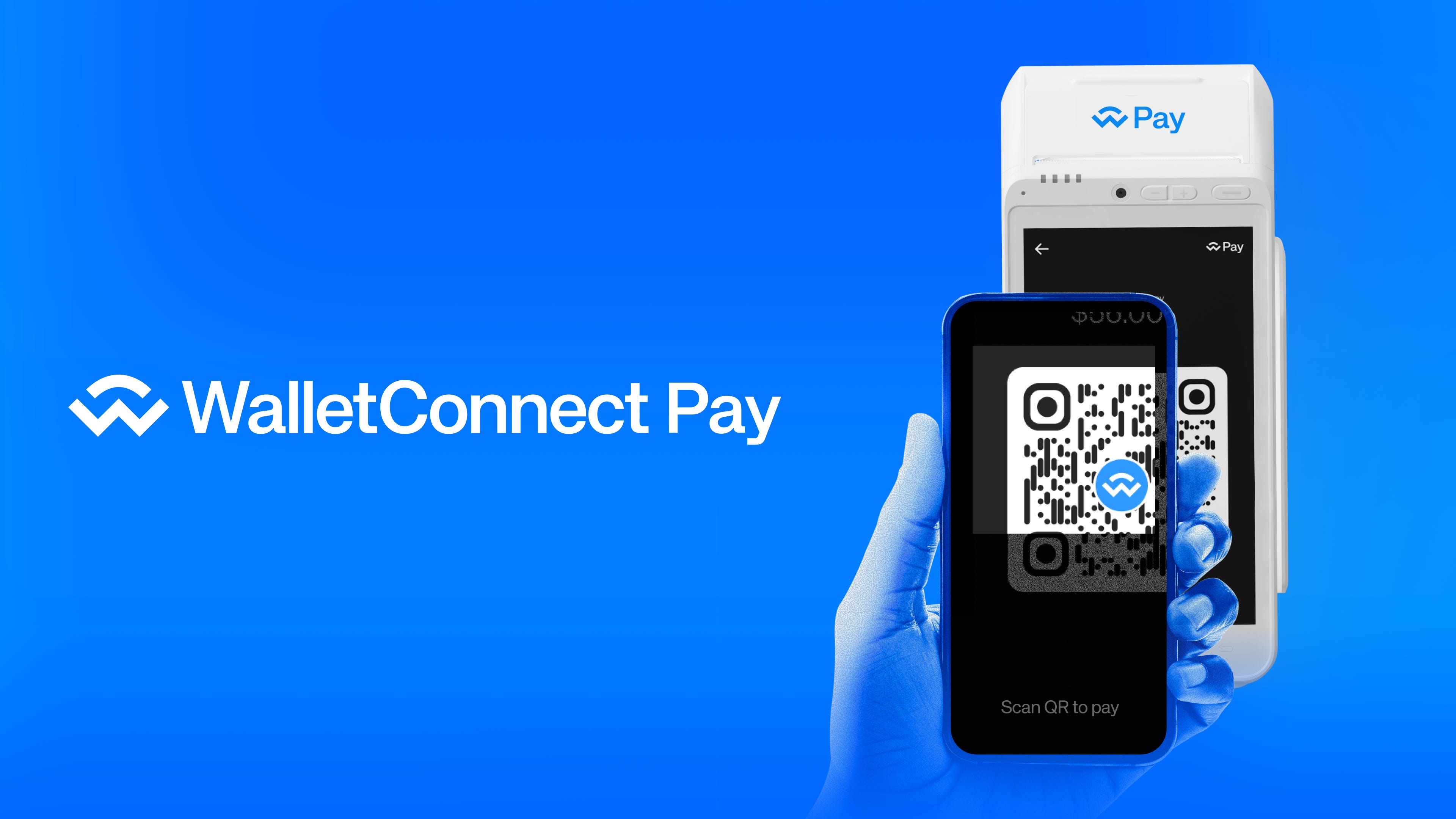
Wallet infrastructure firm WalletConnect made a clear push into payments this month, announcing their global rollout of WalletConnect Pay. The push is backed by Ingenico, a French payments technology provider, who brings WalletConnect Pay to its global network of more than 40 million point-of-sale terminals across 120 countries.
The idea is straightforward: instead of swiping a card that routes payments through Visa or Mastercard, consumers scan a QR code and pay directly from their wallet using stablecoins.
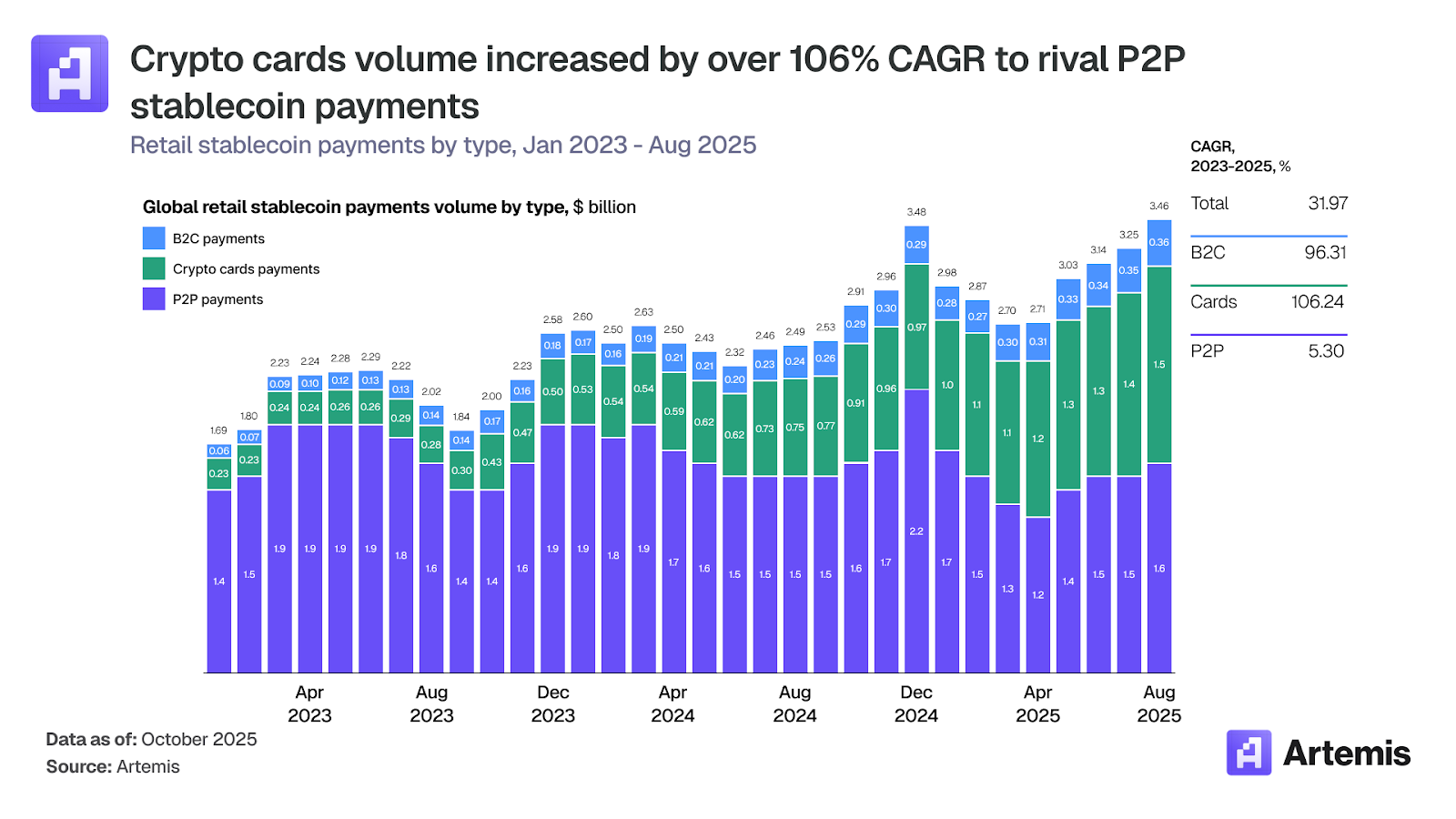
Now, paying with stablecoins isn’t entirely new. In fact, monthly volume of crypto card payments has surged from roughly $100 million in early 2023 to more than $1.5 billion by late 2025, implying a 106% compound annual growth rate. But all of those transaction still rely on Visa and Mastercard rails for settlement.
What’s new here is that WalletConnect Pay is trying to circumvent these networks by settling the payments directly onchain, embedding these payments inside existing payment service provider (PSP) workflows, and thus allowing merchants to accept crypto — while all the complexity is handled for them in the background.
Bypassing these traditional networks not only allows merchants to get paid near-instantly, it also reduced intermediaries involved in the payments and thus significantly cuts fees by around 2-4%. For low-margin businesses like coffee shops, where interchange fees eat into profits on every small purchase, that difference really matters.
Whether the solution gains mainstream traction will come down to merchant adoption and consumer behavior. But the infrastructure is there, and the economics favor disruption.
Bitwise Brings Institutional Asset Management Onchain
Bitwise, a $15 billion digital asset manager, became the first traditional asset manager to launch its own vault-based asset management strategy last month.
To understand why this matters, it helps to clarify what onchain vaults actually are. Vaults function similarly to traditional investment funds — they pool user capital and deploy it into professionally managed strategies designed to generate yield. The key distinction lies in custody. Assets are never held by the manager. They remain locked in smart contracts at all times, with execution happening transparently on public blockchains.
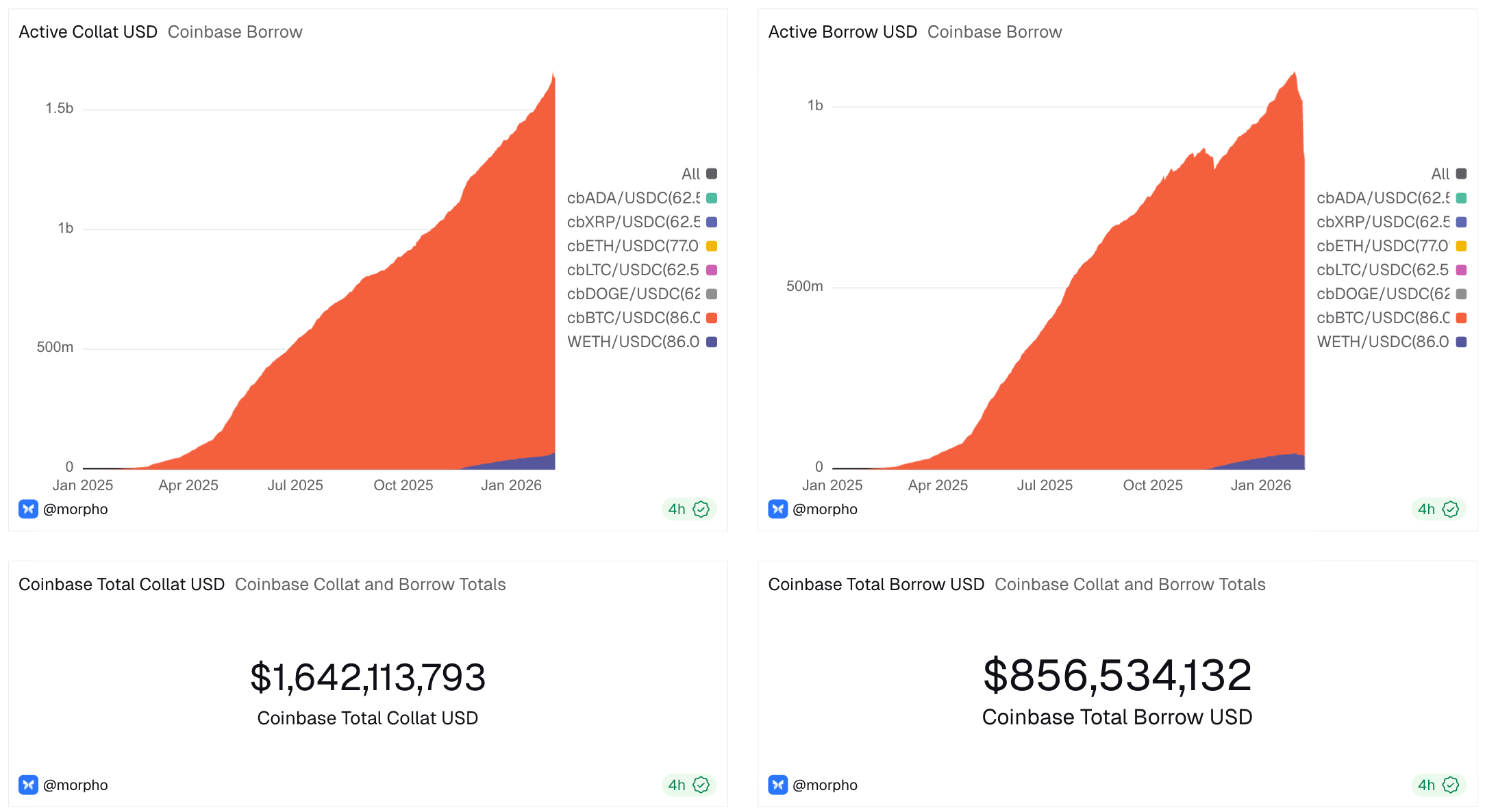
These vaults are one of the fastest-growing primitives in digital assets and are being used by major institutions. Coinbase relies on vault-based architectures for its lending product, allowing users to borrow stablecoins against BTC and ETH. Since launching in early 2025, the product has attracted nearly $2 billion in deposits.
Société Générale’s blockchain subsidiary, SG-FORGE, also uses onchain vaults to support liquidity and distribution for its euro- and dollar-denominated stablecoins.
Now, what sets Bitwise apart is how it approaches vault management. In prior institutional deployments, strategy design and risk management were outsourced to specialized third-party specialists. Bitwise is taking a different path — managing strategy and risk in-house.
The broader implication: onchain infrastructure has reached a level of maturity where traditional asset managers can offer institutional-grade strategies. And looking ahead, Bitwise is unlikely to remain an outlier, as more traditional asset managers are expected to explore similar onchain structures over the coming year.
Gold and Silver Rallies Drive Surge in Onchain Derivatives Trading

The recent surge in gold and silver prices did more than move commodity markets. It offered a clear, practical example of how blockchain-based financial infrastructure is starting to change who can trade assets, when they can trade them, and on what terms.
During the rally, a growing number of traders gained exposure to gold and silver through derivatives offered on decentralized platforms like Hyperliquid rather than traditional exchanges. Why? Because these platforms allow users to trade price exposure to real-world assets directly from a digital wallet, without opening a brokerage account or relying on market opening hours.
Over the last 14 days, the volume on these blockchain-based commodity derivatives broke $20 billion, while reaching roughly 1% of COMEX’s combined daily volume over the last two days. For context, COMEX is the world’s leading derivatives exchange for metals, and this ratio stood at just 0.1% a few weeks ago.
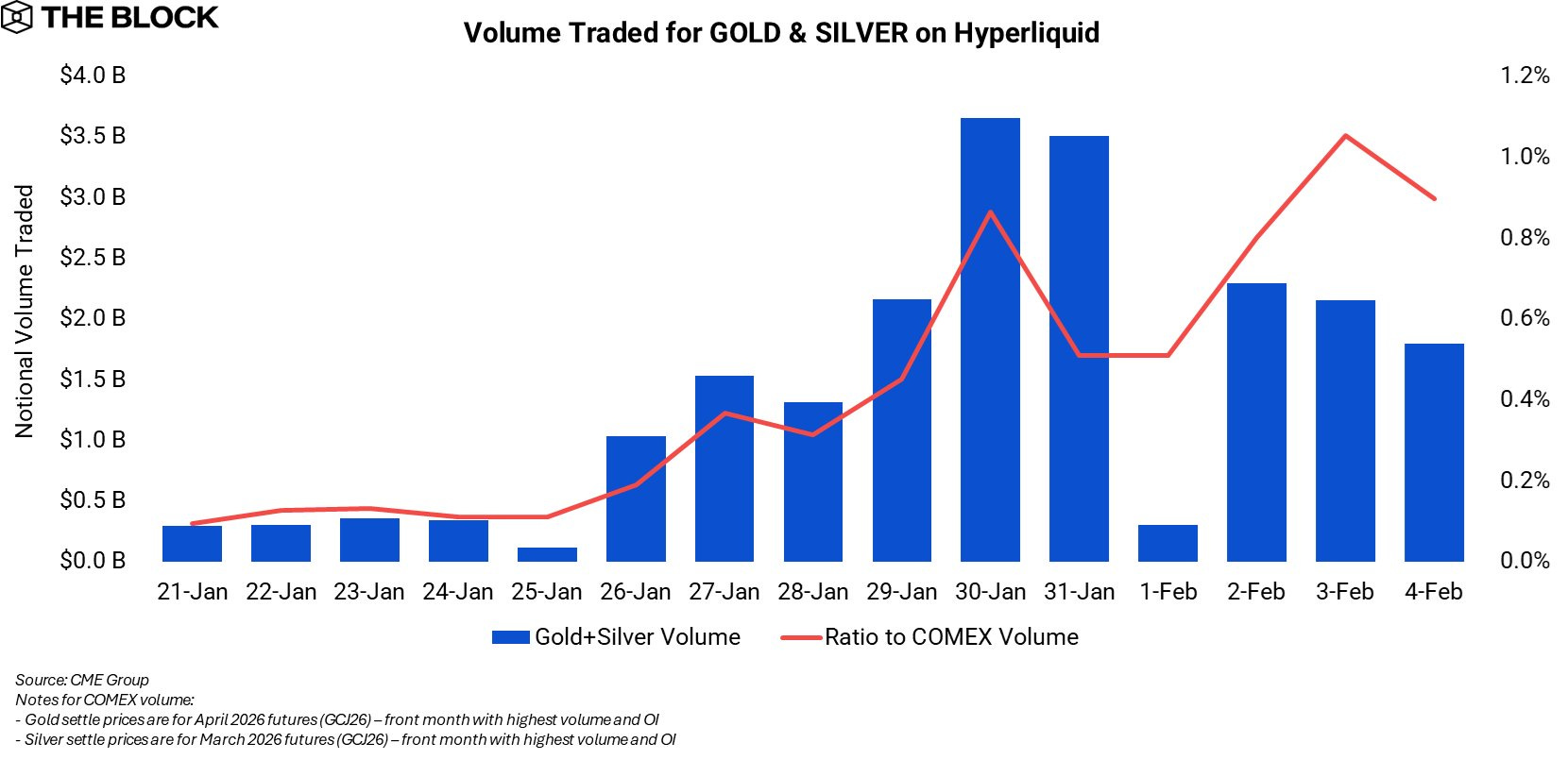
This shows how far blockchain infrastructure has matured, but also how large the opportunity remains. In the coming years, especially as more assets are tokenized and brought natively onchain, these ratios are likely to continue to grow.
Blockwall Portfolio Update

Our portfolio company Spiko reached two major milestones this month. First, it received MiFID authorisation. With that, the team is kicking off its next stage of growth:
European expansion: They can now distribute their tokenized products, which are already industry-leading and attracted $700M+ in deposits, beyond France.
Stronger institutional setup: Spiko can also act as a transfer agent for French funds. This allows asset managers to delegate the burden of register-keeping to Spiko, making partnerships easier to execute.
New products: Enhanced cash products, tokenized private credit, and other higher-yielding offerings become possible. This enables the team to execute on its core mission: building a fully onchain cash- and treasury-management solution for businesses.
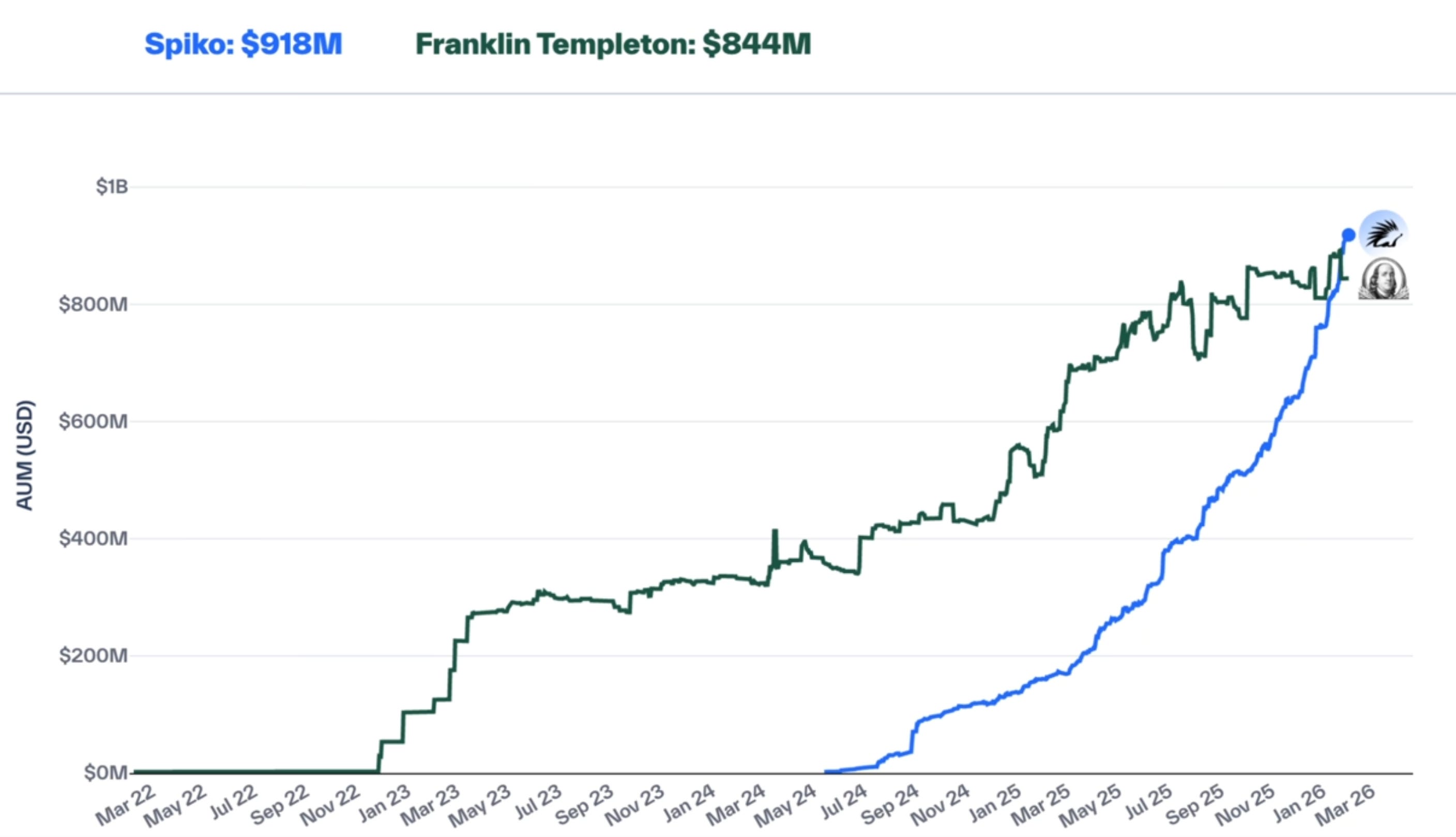
Beyond that, Spiko surpassed $900 million in assets under management, overtaking industry giant Franklin Templeton, which was the first to launch a U.S.-registered tokenized money market fund in late 2022.
Having backed Spiko since their pre-seed stage, it makes us incredibly proud to see where Paul-Adrien Hyppolite, Antoine Michon, and their team are headed.
And we believe that 2026 will be a big year for them.
Key Events of the Last Few Weeks
UBS moves toward crypto trading for wealth clients. The Swiss banking giant is reportedly selecting partners to roll out a crypto offering, initially targeting private banking clients in Switzerland. (Source: Bloomberg)
Bitpanda eyes Frankfurt IPO. Europe’s largest retail-focused crypto platform is said to be preparing for a public listing in Frankfurt in the first half of the year. (Source: Bloomberg)
Bermuda partners with Coinbase and Circle to go onchain. The government is piloting stablecoin payments across its agencies, expanding USDC adoption with local businesses, and helping financial institutions integrate tokenization and other digital finance tools. (Source: Coinbase)
Ethereum Foundation outlines quantum roadmap. The plan includes funding for quantum research and lays out a path toward full quantum resistance over the coming years. (Source: Ethereum Foundation)
What We’ve Been Reading
How Wallets Will Reshape Financial Services (Blockwall) — Our investment manager Max Schneider explores why user-controlled wallets are poised to replace banks and brokerages as the primary gateway to global finance. A look at how the wallet layer could become the new front-end for everything from payments to investing.
The Hidden Power of Prediction Markets (Blockwall) — Our analyst Bjarmi Leó examines how financial incentives turn speculation into truth discovery. The piece goes beyond the gambling narrative and explores prediction markets as data-mining infrastructure for information finance.
Why Open Networks Win (a16z crypto) — This blog post makes a compelling argument for why the value unlocked by truly open networks will always exceed the profit captured by closed ones. For the core insights, see Dominic’s LinkedIn post.
Stablecoins in Payments (McKinsey) — McKinsey’s deep dive into stablecoins as payments infrastructure. The analysis finds that while stablecoins processed over $35 trillion in 2025, only about 1% reflected real-world payments; but that 1% is growing fast, especially in B2B. For the core insights, see Dominic’s LinkedIn post.
12 Charts to Watch in 2026 (Keyrock & Dune) — The firms present 12 data-driven charts capturing the trends that will matter most for crypto this year. From prediction markets to RWA tokenization to DEX derivatives, a useful report for getting a feeling of what will matter in the onchain economy. For the core insights, see Dominic’s LinkedIn post.
Disclaimer
To avoid any misinterpretation, nothing in this blog should be considered as an offer to sell or a solicitation of interest to purchase any securities advised by Blockwall, its affiliates or its representatives. Under no circumstances should anything herein be interpreted as fund marketing materials for prospective investors considering an investment in any Blockwall fund. None of the data and information constitutes general or personalized investment advice and only represents the personal opinion of the author. The author and/or Blockwall may directly or indirectly be exposed to the mentioned assets/investments. For further information please view the full Disclaimer by clicking the button below.
This work is licensed under the Creative Commons Attribution – No Derivatives 4.0 International License. CC BY-ND 4.0 Legal Code | Creative Commons