


Dear Founders, Investors, and Friends,
It’s great to have you back for the June 2026 edition of Blockwall Insights. Here’s what we’re covering today:
Open USD: The New Challenger to Circle’s Stablecoin Stronghold
EUR.BANK: Italy’s Banks Put the Euro on New Rails
Portfolio Spotlight: Tlon - The Messenger Where Every User Gets an AI Agent
Blockwall Portfolio Update
Key Events of the Last Few Weeks
What We’ve Been Reading
Executive Summary
From stablecoin distribution to bank-led euro rails and personal AI agents from Blockwall’s portfolio company Tlon, this edition looks at how new infrastructure is moving into the market.
Open USD challenges the existing economics of stablecoin issuance. With more than 140 listed partners, it proposes distributing most reserve income to the companies generating balances and transaction volume. OUSD does not need to replace USDC to matter. A credible alternative could already pressure Circle to share more of the economics or demonstrate that its margin pays for superior liquidity, compliance and infrastructure. The key question is whether Open Standard can turn a broad coalition into a neutral and operational institution.
EUR.BANK approaches digital money from the banking side. Nine Italian banks are testing a euro stablecoin whose reserves would remain within the banking system. The project aims to support tokenized assets, round-the-clock settlement and cross-border payments while keeping reserve funding within the banking system and banks in the distribution layer.
In our Portfolio Spotlight, we look at Tlon following the public launch of a messenger that gives every user a personal AI agent. Powered by OpenClaw, Tlonbot can retain instructions, perform scheduled work and participate in group conversations. Tlon’s differentiation lies in giving users control over the agent’s accumulated context. They can switch model providers, move their node or self-host without losing the memory and routines built over time.
Open USD: The New Challenger to Circle’s Stablecoin Stronghold
Open Standard lists more than 140 companies as partners in an effort to turn stablecoin issuance from a private profit center into shared infrastructure. The challenge is whether that list can be converted into coordinated action.

Every profitable intermediary eventually faces the same question: What exactly are you being paid for?
For Circle, that question is moving from theory to competition.
On June 30, Open Standard announced Open USD, a dollar-backed stablecoin scheduled to launch later in 2026. Its list of more than 140 partners includes Stripe, Coinbase, Visa, Mastercard, BlackRock, BNY, Solana and Tempo.
The partner list is the advertisement. The revenue model is the product.
Open Standard plans to let businesses mint and redeem OUSD without fees or artificial volume limits. OUSD holders will not earn interest. Instead, after a management fee, most of the income earned on the reserves will be distributed to participating companies based on the balances and transaction volume they generate.
Open USD is therefore not simply another digital dollar. It is an attempt to renegotiate who gets paid when digital dollars circulate.
The product is the economics
Stablecoin issuers receive dollars, create tokens and invest the reserves in assets such as short-duration US Treasuries. The tokens circulate while the issuer earns the interest.
In the first quarter of 2026, Circle generated $652.5 million in reserve income on average USDC circulation of $75.2 billion. Reserve income represented 94% of its $694.1 million in total revenue and reserve income. After $406.8 million in distribution, transaction and other costs, Circle reported $287.4 million in revenue less distribution costs, equivalent to a 41% margin.
This does not mean Circle keeps everything. It already distributes a substantial share of the income to commercial partners, with its Coinbase agreements alone accounting for $330.6 million of costs during the quarter. The dispute is therefore not about whether revenue sharing exists. It is about who controls the terms.
Under Circle’s model, the allocation is negotiated privately with individual partners. Open Standard wants to make revenue sharing a default feature of the product. The issuer would operate as a thinner utility, while the exchanges, payment companies and software platforms generating balances and transaction volume would capture more of the reserve income.
At our 2025 Investor Summit, Christoph Hock, Head of Tokenization & Digital Assets at Union Investment, argued that a model in which issuers retain reserve income while users receive no yield looks more like early-stage arbitrage than a durable market structure. OUSD does not distribute this income to token holders either. It redirects most of it toward the companies producing distribution and usage.
Neither free institutional minting nor revenue sharing is new. Circle Mint is already free for qualifying institutions, while Paxos’ Global Dollar Network shares USDG economics with participating companies. OUSD’s proposition lies in the combination: broad distribution, shared economics and a promise of common governance.
Why Circle is the primary target
Circle’s critics see a profit center. Circle itself sees infrastructure. Both descriptions contain some truth.
Christian Catalini, one of Libra’s creators, makes the strongest case for the challengers: if exchanges, payment companies and software platforms generate the balances and transaction flow, stablecoin issuance should become a low-margin utility rather than the dominant profit center. OUSD gives those companies an alternative through which they could retain more of the underlying economics.
Circle CEO Jeremy Allaire offers the strongest defense of the incumbent model. He points to three advantages that cannot be reproduced simply by offering a more generous revenue split: integrations, primary and secondary liquidity, and the regulatory, banking and treasury infrastructure required to operate at scale. Reserve income pays for more than shareholder profit. It also funds compliance, redemptions, market support and distribution.
A stablecoin looks simple until something goes wrong. Then the invisible machinery becomes the product.
The same applies to network effects. Revenue incentives may attract partners, but they cannot create liquidity on their own. “Liquidity begets liquidity,” as Allaire puts it. Circle has also experienced consortium governance firsthand. USDC began under Centre, a joint initiative with Coinbase, and according to Allaire, even this relatively small structure created substantial coordination problems. Open Standard proposes to align a much larger and more diverse group.
Circle must therefore do one of two things. It can share more of the reserve income, or it can demonstrate that the margin it retains pays for infrastructure and reliability that a more lightly funded consortium cannot reproduce.
The partner list shows reach, not volume
Open Standard has assembled a map of potential distribution. It has not yet created the traffic.
The Open Standard roster covers almost every layer of the digital payments market, but it also represents very different levels of commitment. Stripe says OUSD will become its default stablecoin for businesses. Solana and Tempo plan to support native issuance from day one. Coinbase supports bringing OUSD to Base and other networks, but has not committed to making it a default asset or moving existing balances away from USDC. BNY will explore support, while BlackRock has described the initiative as a “constructive step.”
These statements are not equivalent. ChosunBiz even reported that several Korean companies appearing on the list had held no formal discussions or had agreed only to review the proposal. The roster therefore represents potential distribution, not 140 completed integrations.
The number also overstates independent interests. Stripe, Bridge, Privy and Tempo appear separately, as do Coinbase and Base. And as Lorenzo Valente argues, an exchange, payment network and merchant want different things from OUSD. A logo does not say who will hold balances, route payments or provide liquidity.
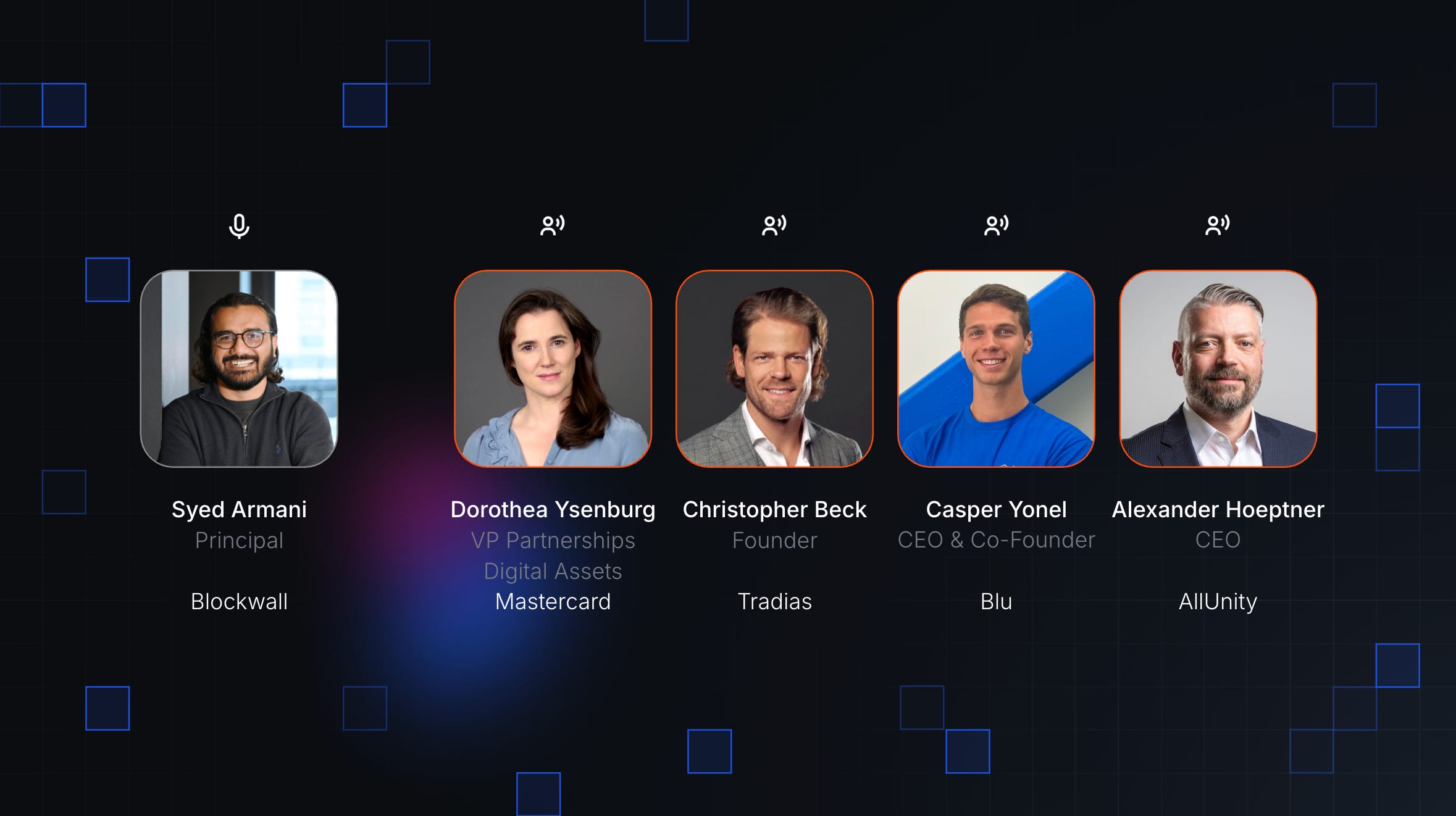
During the stablecoin panel, Dorothea Ysenburg, Mastercard’s Vice President for Global Partnerships in Digital Assets & Blockchain, described Mastercard’s integration logic: the company is open to onboarding compliant stablecoins, but new integrations are typically driven by customer demand. For OUSD, partner support creates a route to distribution. It does not guarantee balances or payment volume. Partnership announcements can open doors, but customers still need to walk through them. The launch metrics that matter will be balances, payment flow, redemption activity, market depth and liquidity across venues.
Governance will decide whether the model works
Open Standard wants the reach of a platform and the neutrality of a standard. That is the promise. It is also the tension the organization must resolve.
Open Standard says an independent company with a partner board will manage OUSD. Its public materials do not yet identify the board members, voting weights, veto rights, recusal rules, issuer, reserve custodians, emergency powers, the level of the management fee or the detailed allocation formula. They also do not explain who can act during a loss of the peg, sanctions event or blockchain failure.
Consortia tend to fail in one of two directions. Too much power sits at the center, or too little power exists anywhere. A high management fee would recreate the economics the project is designed to challenge, while a low fee may leave the institution without sufficient resources for compliance, liquidity management and crisis response. Concentrating authority among a small group would raise questions about neutrality. Requiring broad agreement among more than 140 participants could make rapid decision-making impossible.
Other consortium projects have defined narrower institutional structures. Qivalis brings together 37 banks from 15 countries around a planned euro stablecoin. It has already named its issuer, regulator, management and supervisory board, including independent members and rotating representatives from participating banks. BANCOMAT’s EUR.BANK remains an internal test involving nine banks and no customers, subject to regulatory approval, but its institutional perimeter is nevertheless clear.
Former Commerzbank CEO Manfred Knof captured the motivation during our banking panel: “If, as a bank, you give up payments, then you’re already half out of the business.”
Qivalis and EUR.BANK reflect that concern. Banks do not want to surrender the economics and customer relationships associated with payments to stablecoin issuers or technology platforms. Their narrower structures also illustrate what OUSD still needs to define. Testing, supporting, governing and distributing are different commitments.
OUSD is attempting something more ambitious. It wants to coordinate banks, card networks, exchanges, merchants, blockchains and payment software around the same reserve economics. That breadth creates the network opportunity. It also creates the governance problem. Governance is where the elegant theory meets the untidy institution.
Stripe is the distribution advantage and the governance test
Stripe solves the distribution problem while sharpening the neutrality problem.
Stripe processed $1.9 trillion in 2025 and supports more than five million businesses. If OUSD becomes the default stablecoin across that network, Open Standard will begin with a distribution advantage that few new financial products can match.
Stripe also sits close to much of the surrounding infrastructure. It acquired Bridge, which was cofounded by Open Standard CEO Zach Abrams. It owns wallet provider Privy and incubated the Tempo payments blockchain with Paradigm. OUSD is expected to launch natively on Tempo from day one.
There is no public evidence that Stripe formally controls Open Standard. The more relevant concern is economic concentration. A consortium can be legally independent while still orbiting one company economically.
Abrams has compared OUSD to Android, presenting it as an open system capable of coordinating an ecosystem around shared infrastructure. The comparison is useful, although perhaps not only in the intended way. Android widened participation without eliminating the concentration of influence around Google.
The practical test for Open Standard is therefore straightforward: Could its board make a decision that materially disadvantages Stripe? Voting rights, vendor selection, conflicts of interest and recusal rules will determine whether other participants see a neutral standard or an extension of Stripe’s financial infrastructure.
Coinbase can win either way
Coinbase does not need to choose a winner. It only needs both sides to compete. It has not abandoned USDC. It has added an alternative.
The existing agreement between Circle and Coinbase gives Coinbase payments linked to eligible USDC balances and a share of a residual ecosystem pool. Its initial term reaches its first renewal point in August 2026, although it renews automatically if the relevant conditions are met and the parties do not agree otherwise.
OUSD gives Coinbase access to a second pool of reserve income and greater negotiating leverage with Circle. The option itself has value, even before Coinbase moves meaningful balances. Coinbase can support both assets, compare the economics and redirect activity only when OUSD becomes sufficiently attractive.
For Open Standard, this flexibility is both validation and risk. A platform can endorse OUSD, integrate it and still leave most of its balances and liquidity in USDC. Partnership is not exclusivity. Supporting both systems just makes commercial sense.
USDT is less directly exposed, but not immune
OUSD challenges USDC more directly than USDT. In the first quarter, Tether reported approximately $183 billion of USDT-related liabilities, alongside $1.04 billion in profit and an $8.23 billion reserve buffer.
USDT’s advantage is not primarily access to regulated US payment platforms. It is global liquidity, exchange adoption and entrenched usage outside those channels. Open Standard’s coalition does not immediately reproduce that network.
The more direct confrontation may emerge through USA₮, Tether’s federally regulated dollar stablecoin issued by Anchorage Digital Bank. OUSD and USA₮ will compete more directly for regulated enterprise distribution in the United States. Tether also has sufficient earnings power to fund its own incentives if revenue sharing becomes a standard expectation in the market.
Our take
Open Standard has built a coalition. It has not yet built a standard, and the gap between the two is the whole story.
Strip away the logo wall and OUSD is really a bet that stablecoin issuance is becoming a commodity. If 140-plus companies can credibly threaten to route reserve income to whoever holds the balances, the issuer’s margin was never a moat; it was a toll waiting to be renegotiated. We think that renegotiation happens whether or not OUSD itself ships. Its real function is to hand large distributors a credible outside option, and an outside option is enough to reprice the incumbent.
Which is why we watch where the economics land, not the OUSD-versus-Circle scoreboard. Our thesis since 2018 has been that infrastructure gets built first and value then migrates up the stack to whoever owns the customer. A model where reserve income follows balances and volume is a model where stablecoin value accrues to distribution and applications. That is precisely the layer we back at Pre-seed and Seed: the companies that generate those balances and volume in the first place. Commoditized issuance is not a threat to that thesis. It is the setup.
For the founders we back, that repricing, not the winner of the issuer fight, is the opportunity.
EUR.BANK: Italy’s Banks Put the Euro on New Rails
Nine Italian banks are testing infrastructure and use cases for a planned euro stablecoin designed to keep reserve funding within the banking system.

BANCOMAT has moved EUR.BANK into its first technical testing phase. Nine Italian banks are participating: Banca Generali, Banca MPS, Banca Sella, Banco BPM, BPER Banca, Cassa Centrale Banca, CREDEM, Crédit Agricole Italia and Intesa Sanpaolo. The tests exclude customers and focus on infrastructure and use cases. Any operational launch remains subject to regulatory approval.
The key feature is where the money stays. BANCOMAT says the reserves backing EUR.BANK would remain within the banking system, preserving bank funding and strengthening depositor protection. The project is intended to support tokenized financial instruments, round-the-clock onchain payments and settlement, and cross-border corporate flows.
BANCOMAT CEO Fabrizio Burlando later told TPI that buying a stablecoin typically moves deposits from a bank to the issuer. EUR.BANK instead creates an interbank structure in which the reserves remain at the banks. He said BANCOMAT aims to obtain the necessary authorizations by year-end and begin issuance in Q1 2027. EUR.BANK remains a codename.
Blockstories reports that FlowPay is expected to issue the first token, while participating banks handle distribution. Banca Sella, BPER and Intesa Sanpaolo are also members of Qivalis, a separate euro stablecoin consortium of 37 European banks.
Their participation in both projects does not necessarily imply a conflict. It does show that Europe’s bank-led stablecoin market is still taking shape. The same institutions may support several rails before deciding where to concentrate liquidity and distribution, leaving open whether EUR.BANK and Qivalis become complementary networks or competitors for the same euro balances.
For banks, the issue extends beyond issuing a token. Payments determine where deposits sit, who controls the customer relationship and which infrastructure captures the economics. EUR.BANK is designed to bring the euro onchain without moving those advantages outside the banking system.
Portfolio Spotlight: Tlon - The Messenger Where Every User Gets an AI Agent
Blockwall invested in Tlon around a “decentralized everything app for the West”: one interface for communication and services without handing permanent control over identity and data to a platform operator. After a private beta, Tlon Messenger launched publicly in June. The product makes that thesis tangible: every account combines a messenger running on a personal server with Tlonbot, a ready-to-use, OpenClaw-powered agent.
Tlonbot turns a personal agent into shared group infrastructure. It has its own cryptographic identity and can join conversations as a participant. In our own use, we configured a Tlonbot to deliver a recurring Web3 briefing into a dedicated group. It published the digest on schedule and let every member ask follow-up questions against the same context. One person configures the workflow; everyone else receives the utility without installing or hosting OpenClaw.
“A lot of people do this with OpenClaw, but can’t give OpenClaw to their friends. We solve that problem.”
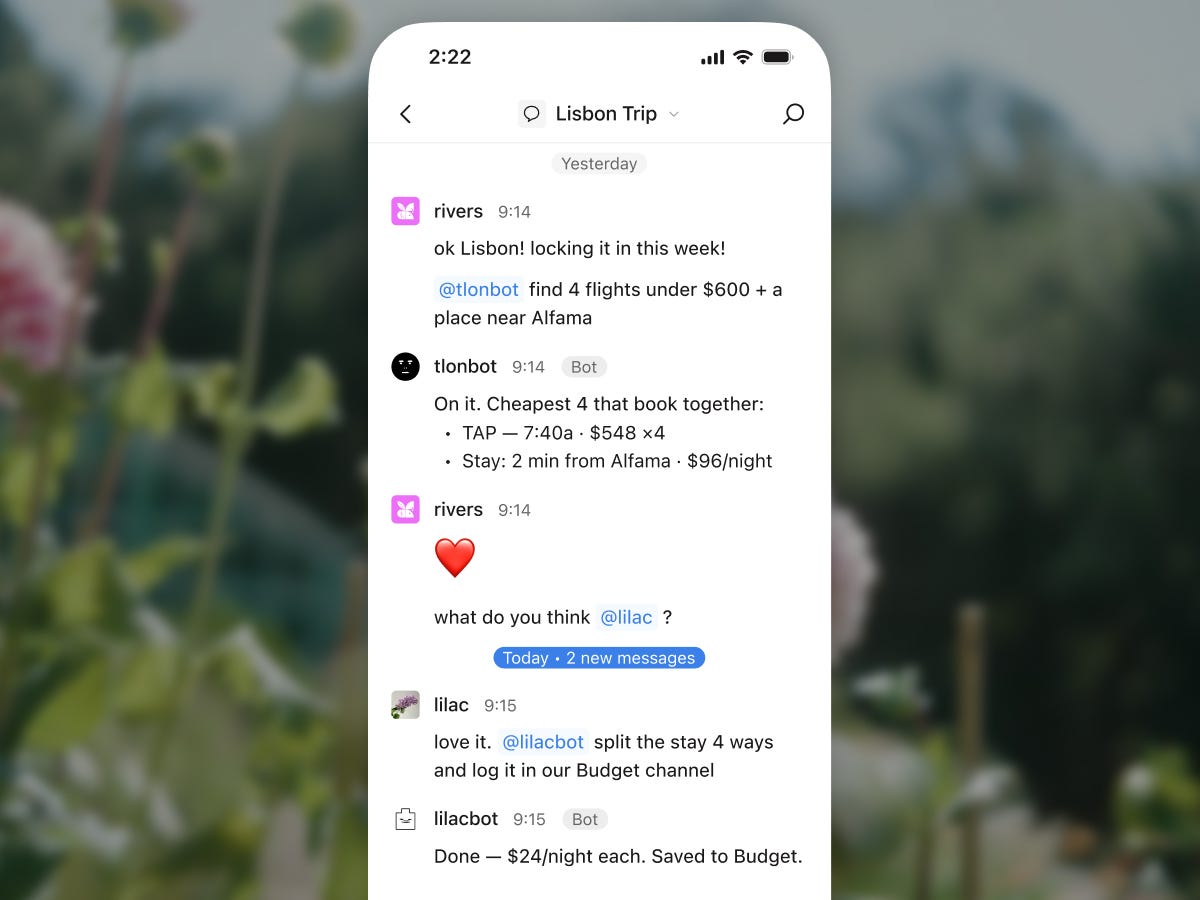
This is where OpenClaw matters. It is not the model, and it is more than a search feature. It is the open-source runtime connecting a model to memory, tools, scheduled work and messaging. The model supplies intelligence, while OpenClaw provides continuity and agency. Inside Tlon, Tlonbot can retain instructions, produce recurring briefings, monitor a channel, summarize missed conversations, and create or manage groups. A model is included for basic use, while users can connect an Anthropic, OpenAI or OpenRouter API key. In the hosted setup, inference is handled by the provider they select.
AI inside a chat is not unique: WhatsApp has Meta AI in group conversations, while Telegram supports guest AI bots, bot-to-bot workflows and chat automation. Signal remains focused on private messaging; its current feature catalog does not yet include a native assistant or supported bot layer. Tlon’s differentiation is the combination: every user receives an agent, that agent can join a group, and its context is not tied to one model or messaging vendor. WhatsApp’s assistant remains a Meta product, while Telegram bots generally depend on a developer and that developer’s backend.
This matters because the valuable part of a personal agent is not only the model. It is the memory built over time: preferences, relationships, routines and private context. “Agents need memory and compute to be really useful.” In Tlon, that persistent state lives on the user’s node. Users can switch models, move their node or self-host without losing the memory, routines and context accumulated over time.
This is why Blockwall continues to believe in the original thesis. We did not invest in another feature for chat. We invested in a user-controlled interface that could expand from messaging into a broader layer for software and services. The product logic is personal first, community second. AI has strengthened that case: the information people share with an agent, from medical questions to other highly personal topics, makes user control over the underlying data more important, not less.
Tlon still has to prove that this architecture produces repeated use and organic distribution. But the public launch makes Blockwall’s thesis testable: if messaging becomes the control layer for personal agents, ownership of the agent and its context is not a niche privacy feature. It is part of the product.
Download Tlon Messenger for iPhone or Android.
Blockwall Portfolio Update
Flyra comes out of stealth with backing from Coinbase Ventures
Flyra announced an investment from Coinbase Ventures’ Base Ecosystem Fund, alongside Rally Cap, Goodwater Capital’s Genesis Fund, and Kleiner Perkins. Its stablecoin-native infrastructure enables platforms to launch global financial products within 60 days.
Validation Cloud launches Mavrik, its agentic suite for digital assets
Validation Cloud launched Mavrik, an AI-powered platform that helps financial institutions analyze and act on stablecoin, tokenized-asset, and DeFi activity through real-time data and automated workflows.
Spiko powers Bitstack’s new euro yield product with Amundi
Spiko’s Amundi Overnight Swap Fund now powers Bitstack Boost, a euro savings product offering a 2.5% net yield to Bitstack’s 350,000 users and expanding Spiko’s consumer distribution.
Spiko launches stablecoin deposits and withdrawals with Coinbase
Spiko now supports EURC and USDC subscriptions and redemptions through Coinbase Payments. The integration makes its funds the first UCITS products to accept stablecoin payments natively.
Key Events of the Last Few Weeks
Robinhood launches its Chain mainnet, Stock Tokens, and agentic trading
Robinhood launched its Arbitrum-based Layer 2 for tokenized assets, expanded 24/7 Stock Tokens to more than 120 countries, and introduced DeFi lending through Morpho.
Open Standard introduces Open USD
Open USD is a new stablecoin initiative backed by more than 140 companies, including Visa, Mastercard, Stripe, Coinbase, and Shopify. Partners will share reserve economics and governance.
Framework Ventures raises $400 million
Framework Ventures closed its fourth fund to invest across crypto, AI, robotics, and energy. The broader mandate reflects increasing convergence between crypto and other frontier technologies.
Mastercard launches Agent Pay for Machines
Mastercard launched infrastructure enabling AI agents to make permissioned payments across cards, bank accounts, and stablecoins. More than 30 payments and blockchain partners are participating.
Morpho Association raises $175 million
Morpho raised $175 million from Paradigm, a16z crypto, Ribbit, and strategic investors. With more than $11 billion in deposits, the protocol is becoming a core lending infrastructure provider for major crypto platforms.
Securitize completed its SPAC merger at a $1.25 billion valuation and raised approximately $400 million. The company is the first listed pure-play tokenization platform and manages more than $4 billion in tokenized assets.
Banca Sella Becomes Italy’s First Bank to Receive a MiCA-CASP Authorization
Banca Sella became Italy’s first bank to receive a MiCA-CASP authorization from the Bank of Italy. The license allows it to offer crypto custody and transfer services, with a regulated digital asset offering planned for clients later in 2026.
What We’ve Been Reading
AI, Atoms & Association — Outlier Ventures
Outlier Ventures outlines its investment thesis around the convergence of AI, physical technologies, and decentralized coordination, illustrating how Web3 investors are expanding into adjacent sectors.
Why crypto VCs are expanding beyond crypto — The Block
The article examines why firms such as Framework, Paradigm, Haun Ventures, and YZi Labs are broadening their mandates into AI, robotics, and frontier technology.
RWAs: The Logical Conclusion of Stablecoins — Archetype
Archetype presents a framework for tokenized real-world assets and argues that stablecoin adoption will progressively drive capital into a wider range of onchain financial products.
Europe’s MiCA crypto regime is fully in force — The Block
Only 244 of more than 3,000 previously registered crypto firms have secured MiCA authorization. The regime is expected to accelerate consolidation among European crypto service providers.
2026 Q2 Crypto Industry Report — CoinGecko
CoinGecko reviews a difficult quarter in which crypto market capitalization declined 12.6%. Prediction markets remained a key growth segment, with quarterly notional volume increasing 46% to $111.7 billion.
Thanks for reading Blockwall Insights! Subscribe for free to receive new posts and support our work.
Disclaimer
To avoid any misinterpretation, nothing in this blog should be considered as an offer to sell or a solicitation of interest to purchase any securities advised by Blockwall, its affiliates or its representatives. Under no circumstances should anything herein be interpreted as fund marketing materials for prospective investors considering an investment in any Blockwall fund. None of the data and information constitutes general or personalized investment advice and only represents the personal opinion of the author. The author and/or Blockwall may directly or indirectly be exposed to the mentioned assets/investments. For further information please view the full Disclaimer by clicking the button below.
This work is licensed under the Creative Commons Attribution – No Derivatives 4.0 International License. CC BY-ND 4.0 Legal Code | Creative Commons