


Dear Founders, Investors, and Friends,
It’s great to have you back for the Q3 2026 edition of Blockwall Insights. Here’s what we’re covering today:
Blockwall Portfolio Update
When Distribution Becomes Infrastructure
Ondo Puts the Portfolio Onchain
Swift Connects Tokenized Deposits
Cloudflare Builds a Checkout for AI
Token Funding: A New Route to US Investors
Key Events of the Last Quarter
What We’ve Been Reading
Executive Summary
Q3 brought blockchain infrastructure further into financial services, with tokenized investment portfolios, live bank-to-bank payment tests and new tools designed to let AI agents buy digital resources.
Portfolio Highlights
Blockwall co-led functionSPACE’s $1.7 million pre-seed round. Its markets combine numerical outcomes in a shared liquidity pool, allowing participants to trade thresholds and ranges without fragmenting liquidity across separate contracts.
Spiko crossed $2 billion in July and reported $2.67 billion by 22 September. Its Smart Cash Euro fund received S&P’s AAAf and S1+ ratings for credit quality and volatility.
Spherity earned ISO/IEC 27001 certification and developed digital logistics records. Rebind reported 20,000 downloads and added dollar and Swiss-franc savings, while Busha introduced stablecoin-backed cards and simpler crypto transfers.
Articles
Robinhood’s chain lets stock tokens move between applications and serve as collateral for other positions. Its 28.6 million funded customers give it a distribution advantage as external developers build around those assets.
Ondo brings portfolio management into crypto wallets through single tokens based on BlackRock allocation models, with automatic rebalancing. Asset managers gain another channel for distributing diversified investment products.
Swift’s live tests connect tokenized deposits across banks while retaining existing settlement systems. Its design allows customers to receive funds before final interbank settlement, leaving banks to manage the exposure during that interval.
Cloudflare plans to let websites charge AI agents per request within predefined spending limits. Publishers could earn from content consumed by AI even when readers never visit their sites.
The SEC’s proposal would let eligible projects raise up to $75 million annually, including from retail investors. It would open a dedicated public fundraising route without creating an equivalent exemption for exchanges trading those tokens.
Blockwall Portfolio Update
Blockwall co-leads functionSPACE’s $1.7 million pre-seed round
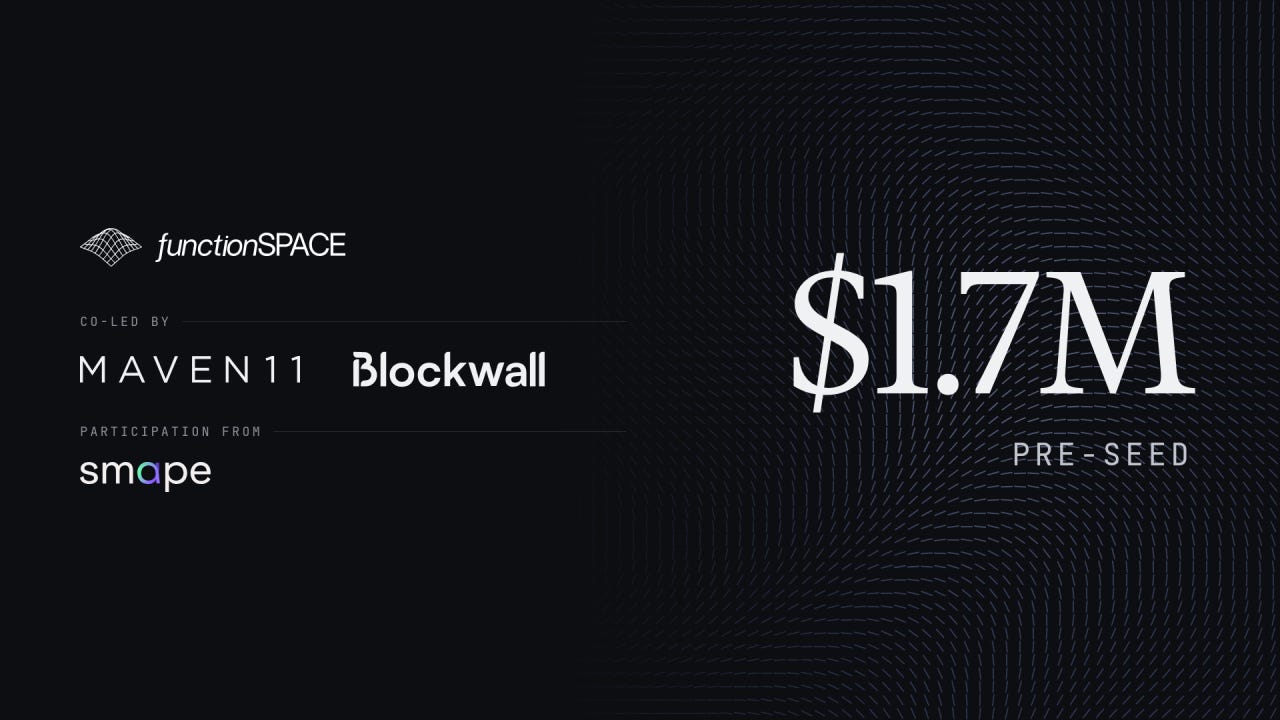
We are proud to announce our investment in functionSPACE, co-leading its $1.7 million pre-seed round alongside Maven 11 Capital, with participation from SMAPE Capital. The funding has supported research and development, with the market design tested in three public campaigns.
functionSPACE is building markets for outcomes expressed as numbers, such as a company’s quarterly revenue, a film’s opening-weekend takings or an economic data release. These forecasts are often split across separate yes-or-no markets, each with its own liquidity. functionSPACE brings the full range of possible outcomes into one market. Participants can choose a threshold, take an over-or-under position or back a specific range, with each position drawing on the same liquidity pool. For example, someone forecasting a film’s opening weekend could back revenues between $60 million and $95 million.

The team brings experience from Nethermind, Sky, Banxa and Synthetix. Our investment reflects our view that prediction markets can turn dispersed information into useful price signals and tools for managing risk. Financial incentives give participants a reason to contribute informed views. functionSPACE could extend that approach, making it easier to express specific expectations and price risks that standard contracts do not cover.
Spiko passes $2 billion and expands its product range
Spiko crossed $2 billion in assets under management in July, five months after reaching its first billion. By 22 September, the company reported $2.67 billion across its products, 13,784 active users and $38.1 million in interest accrued for clients.
S&P Global Ratings also assigned Spiko’s Smart Cash Euro fund AAAf for credit quality and S1+ for volatility, the highest assessments on their respective scales. Distribution expanded through Coinhouse and GoDutch, which now offer Spiko products within their own platforms. The quarter also brought the launch of Cash & Carry, a fund that seeks to earn returns from price differences between spot assets and futures, broadening the offering beyond its existing cash-management products.
Spherity earns ISO certification and develops industrial applications
Spherity achieved ISO/IEC 27001:2022 certification for the information-security systems supporting its VERA digital product passports and CARO pharmaceutical compliance solution. With Fraunhofer FIT and TALKE, it developed digital cleaning certificates for chemical logistics, replacing paper records with digitally signed, verifiable documents. The solution is available for companies to test.
Rebind adds dollar and Swiss-franc savings
Rebind reported 20,000 downloads across Europe and expanded its savings offering beyond euros, adding US dollars in July and Swiss francs in August.
Busha expands payments and transfers
Busha launched stablecoin-backed virtual Visa cards and introduced Mastercard Crypto Credential in Nigeria, allowing eligible customers to transfer supported digital assets using email or phone aliases.
When Distribution Becomes Infrastructure

For years, Robinhood, the US retail brokerage, built its appeal around making investing easier. Its next ambition reaches deeper into the machinery of financial markets.
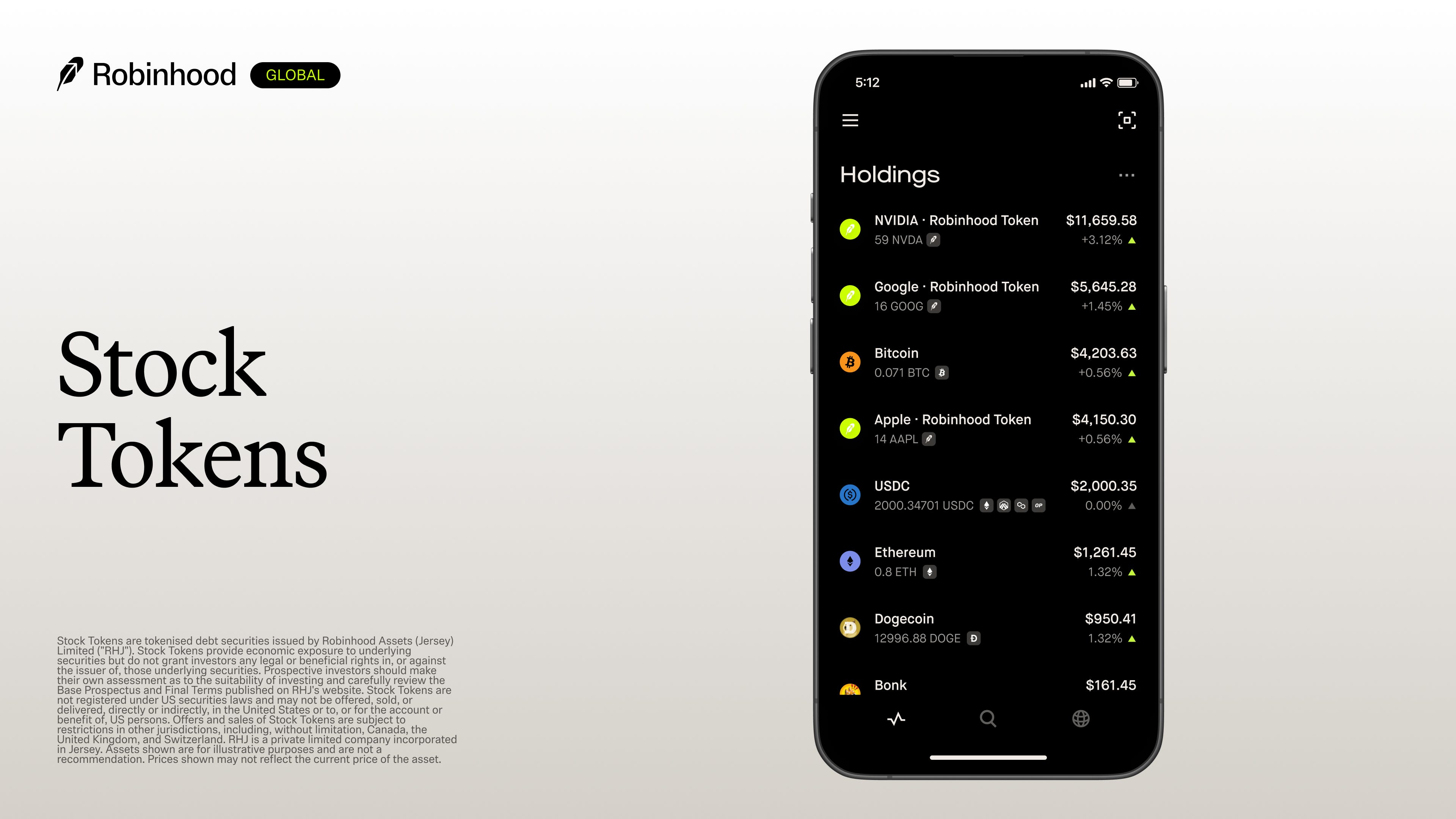
On July 1, the company launched Robinhood Chain, bringing transferable Stock Tokens, continuous trading and DeFi applications into a shared network. Investors can hold exposure to familiar companies in their own wallets, while developers can build financial products around those assets.
That combination deserves attention. At the end of August, Robinhood had 28.6 million funded customers and $383.7 billion in platform assets. Those customers have not automatically become blockchain users. But Robinhood starts with something most new networks spend years trying to establish: a relationship with people who already trust it with money.
The opportunity is substantial. So is the tension between opening financial infrastructure and becoming the company through which much of that infrastructure is accessed.
What Robinhood has built
Robinhood Chain is a dedicated network built with Arbitrum technology that settles directly to Ethereum, making it an Ethereum Layer 2. It processes transactions on its own network, while Ethereum provides the underlying settlement infrastructure. Independent developers can deploy applications, allowing products from different providers to interact through shared infrastructure. The network still has its own operating and governance arrangements, which matter for its security and economics.
The ecosystem connects several functions. Stock Tokens supply familiar investment assets. Stablecoins provide money for trading and lending. Wallets hold the assets and connect users to applications. DeFi protocols supply the markets.
Uniswap, the leading decentralized exchange protocol, was available from day one through its trading infrastructure, wallet and developer interfaces. Robinhood Earn lets customers lend USDG, a dollar-backed stablecoin issued by Paxos, through Morpho, an onchain lending protocol. At launch, Earn advertised an estimated 7% annual yield.
Lighter, a decentralized derivatives exchange, provides perpetual futures, contracts without an expiry date, and accepts selected Stock Tokens as collateral. Its current Robinhood Chain documentation lists SPY and USO with a 50% loan-to-value allowance.
An investor can therefore hold market exposure while using part of its value to support another position. This is what crypto calls composability: an asset becomes usable across several financial applications. It also connects their risks. Falling collateral prices can trigger liquidations that feed selling pressure back into token markets.
Actual use was still limited early in the summer. In a July interview, Token Terminal analyst Frederick Hopkins cited $2.3 billion in outstanding tokenized equities across the market, but only $23.1 million deposited in lending markets. Issuing assets and establishing demand for their use as collateral are different stages of adoption. Robinhood’s integrations create the opportunity to connect them.
The same infrastructure supports automated portfolio tools and trading agents. Uniswap’s APIs let developers incorporate execution into applications without building an exchange themselves. Automation can make these products easier to use; it does not make the underlying investment decisions better by default.
Availability remains fragmented. Stock Tokens launched for eligible users in more than 120 countries, excluding the US and US persons. Earn initially targeted eligible US customers. Robinhood is assembling a global ecosystem, but its products operate within different regulatory boundaries.
Why build a chain?
In a September discussion, Vlad Tenev described tokenization as a “freight train.” The more useful part of his argument concerned the difficulty of extending traditional trading hours: exchanges, brokers and other infrastructure providers must coordinate changes across separate systems.
A conventional database can operate around the clock. Blockchain’s stronger proposition is a common asset and settlement environment that applications from different firms can connect to. Integrations and compliance checks remain necessary, but each new service can build on infrastructure already in place.
For Robinhood, this could shorten the distance between introducing an asset and making it useful. A new token can become accessible to existing trading, lending and portfolio infrastructure. Outside developers can expand the product catalog, while Robinhood participates in the network’s economics.
The practical test is whether this produces better access, execution and capital efficiency. Faster technology matters when those benefits reach the customer.
What investors actually own
The term “Stock Token” compresses an important distinction. Robinhood’s products are tokenized debt securities issued by Robinhood Assets (Jersey) Limited. They provide economic exposure to underlying securities without granting legal or beneficial rights in those shares.
The issuer says the tokens are backed by equities held in custody. Dividends are reinvested, increasing the exposure represented by each token through a multiplier. Holding the token in a personal wallet changes custody of the token; the underlying shares still depend on the issuer and its service providers. RHJ also states that it is not regulated, and that its Jersey consents do not constitute prudential supervision.
These distinctions became public flashpoints in early September, when AMC CEO Adam Aron demanded that Robinhood stop offering AMC-linked tokens, challenging the use of the company’s name and the absence of shareholder rights. Robinhood defended the product. The dispute exposed a question that will follow equity tokenization: what should investors understand themselves to own when a familiar company’s ticker appears in a new market?
There is useful financial innovation here, but the terminology needs to keep up. Exposure, backing and shareholder rights describe different things. On September 14, Robinhood’s crypto head Johann Kerbrat still described redemption into actual shares and voting rights as roadmap items. A credible market must make the distinction between what investors receive today and what is being developed easy to understand.
Continuous trading introduces another complication. The token market can remain open while the underlying stock market is closed, making hedging and arbitrage harder. Tokens may trade at premiums or discounts. For an investor borrowing against them, that gap can affect liquidation risk even if the underlying company’s prospects have barely changed.
What early activity shows
Early trading was substantial. SQD measured $2.21 billion in cumulative volume across pools containing Stock Tokens through August 30, including $1.69 billion between August 1 and 30. Its methodology counts each swap once and includes all counterpart assets.
The composition is more revealing than the headline. Dollar tokens represented 54.7% of volume; tokens outside the official registry, predominantly memecoins, accounted for 32.1%. Familiar equities were entering crypto’s existing trading culture.
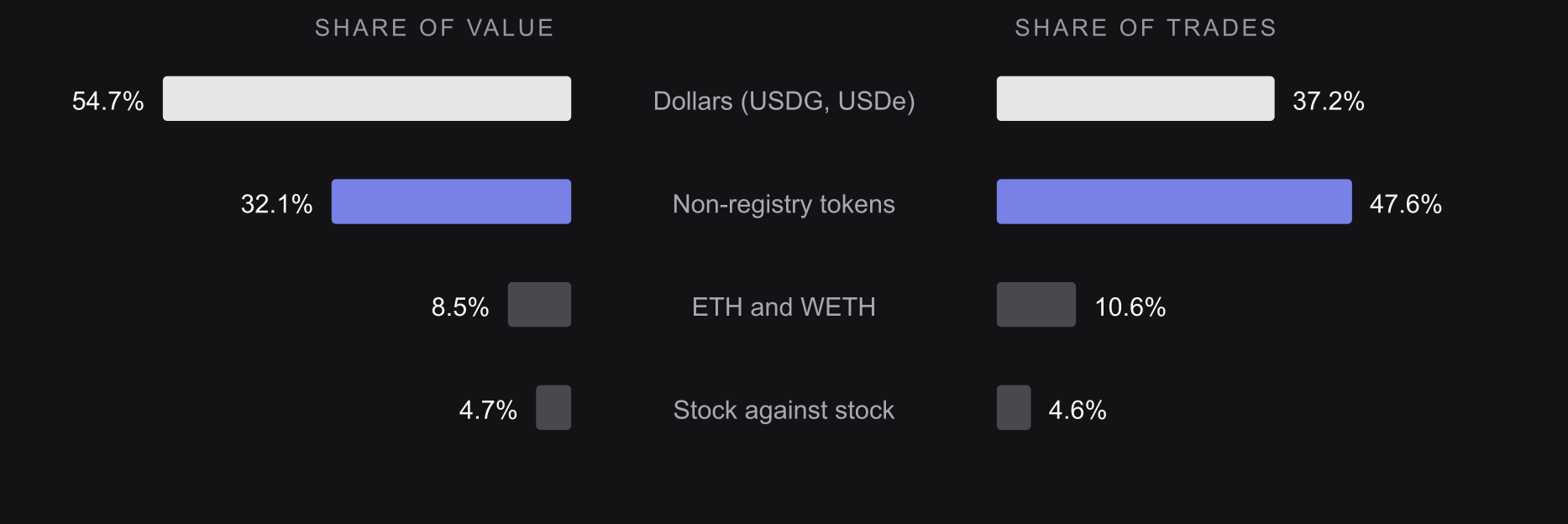
We see that as evidence of experimentation, with an unresolved question about durability. Open markets invite uses beyond the issuer’s original intentions. Speculative activity can attract liquidity, but repeated trading by bots or a small group of participants cannot establish broad investor adoption. The figures do not identify how many Robinhood brokerage customers moved onchain.
By end of Q3, DefiLlama tracked approximately $1.03 billion in total value locked in DeFi protocols on Robinhood Chain, $1.03 billion in stablecoins and $87.60 billion in decentralized-exchange trading volume. These figures cover the broader ecosystem, including assets beyond Stock Tokens. Stablecoin holdings and protocol deposits can overlap and should not be added together.
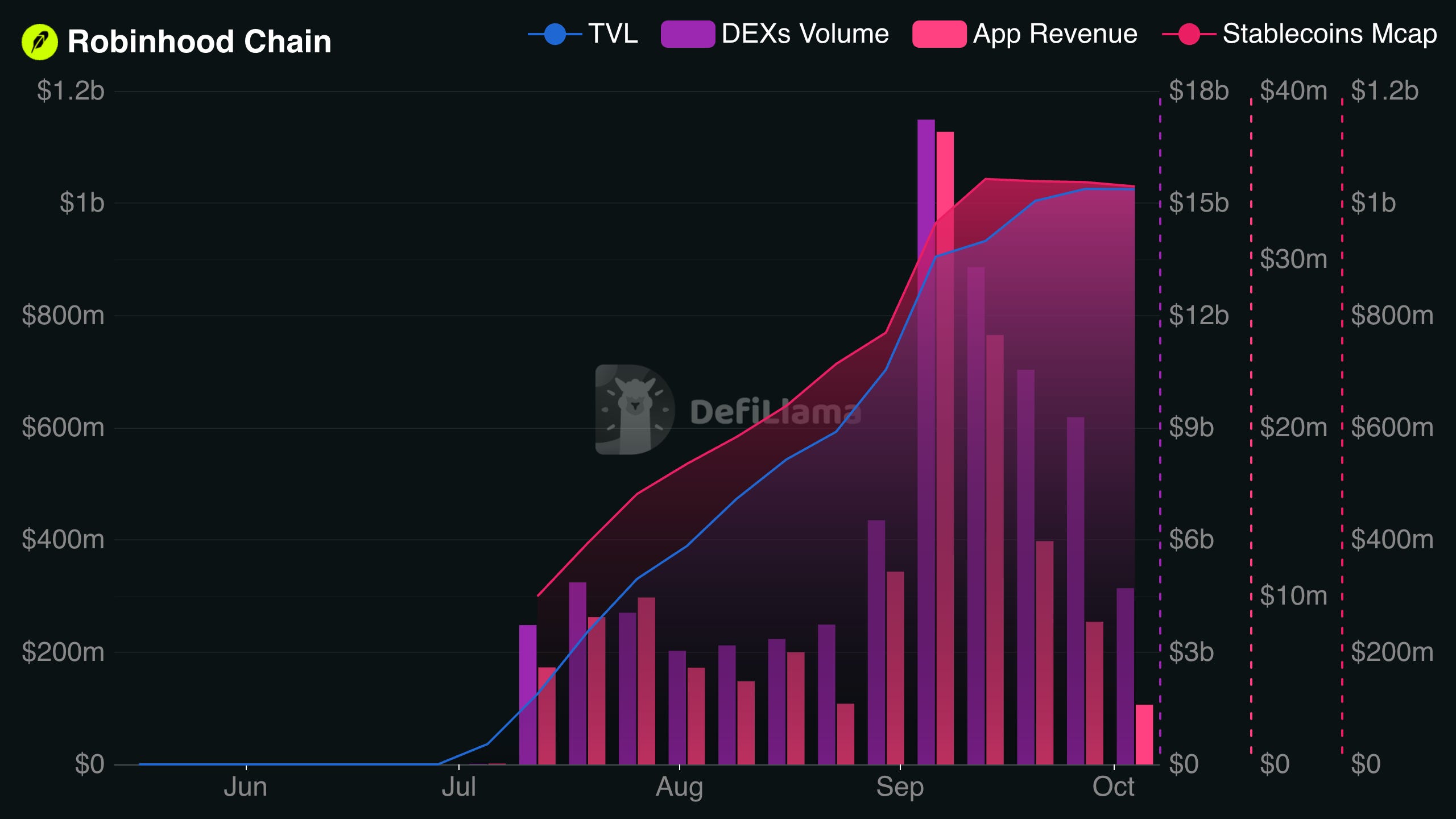
The next evidence we want is more ordinary: investors returning, balances staying, and meaningful trades executing at reasonable prices when markets are stressed. Those measures will tell us more about lasting demand than another transaction milestone.
The business underneath the blockchain
Robinhood has a commercial reason to make this work. In Q2 2026, before the chain launched, it generated $1.31 billion in revenue. Net interest contributed $389 million, while cryptocurrency transaction revenue fell 38% year-on-year to $100 million. The business already earns from several parts of a customer’s financial activity. Crypto trading alone remains cyclical.
A chain adds income from processing network transactions. Under its launch-partner arrangements, Robinhood retains 50% of sequencer revenue, earned from ordering transactions, up to approximately $50 million in cumulative revenue, 70% until approximately $150 million, and 85% thereafter. These are revenue shares, not profit margins. Fees earned by independent applications are separate.
The larger opportunity, in our view, is to remain the place where customers discover, fund and use their next financial product. External developers can broaden that offering without Robinhood financing every experiment itself.
That creates a difficult balance. Developers benefit from access to a familiar platform, but commercial distribution depends on integrations, visibility and customer preference. Deploying an application on the chain does not guarantee placement inside Robinhood’s products.
Technical governance is also more nuanced than the branding suggests. Robinhood holds two of eight Security Council seats; routine actions require six signatures and a seven-day delay, while validators remain permissioned. These safeguards matter, but they address different powers from control over a prominent customer interface.
Our take
We think Robinhood has a credible shot at making onchain finance an ordinary part of investing. Crypto has developed markets for trading, lending and stablecoins; established financial platforms bring customer relationships and familiar assets. Robinhood connects the two through products people can actually use. That gives the convergence of crypto and traditional finance a concrete commercial expression.
The value proposition depends on the investor. For eligible users who struggle to access U.S. equities, access itself can be a meaningful improvement. For those already well served by a conventional broker, the case needs to go further: easier use of investments as collateral, better financing terms or useful portfolio tools. Robinhood’s task is to turn the technical possibilities of tokenization into benefits that give customers a reason to use these products.
We would also resist dismissing Stock Tokens simply because they offer indirect exposure. Finance already has many ways to separate economic exposure from direct ownership. Their legal protections differ substantially: beneficial ownership through a broker and a debt claim against a token issuer are different arrangements. We would judge the product by the enforceability of its claims, the transparency of its backing, its redemption terms and the access it provides. The familiar ticker should be the beginning of that assessment.
The harder commercial question is who captures the value. Robinhood can broaden access while gaining influence over how customers discover and use financial products. For developers, its distribution could be valuable, but relying on a company that also operates competing products creates platform risk. An open network will support a healthier ecosystem if independent applications can reach customers and retain viable economics.
For an early-stage investor, that points towards businesses with a reason to exist beyond their placement inside one wallet: better portfolio tools, reliable pricing, effective risk management and customer relationships of their own. Robinhood’s reach can accelerate their growth. Their durability will depend on the service they provide and their ability to serve customers across platforms.
July and August established that activity can arrive quickly. We would be more impressed by investors repeatedly using these assets across trading and financing than by another transaction milestone. If Robinhood can combine that usefulness with clear rights and dependable liquidity, this summer’s launch could mark a lasting change in how investment products are distributed and used.
Ondo Puts the Portfolio Onchain
Ondo combines tokenized assets into complete portfolios, giving asset managers another way to reach investors through crypto wallets.
On September 24, Ondo introduced Intelligent Portfolios, allowing investors to hold a basket of investments through a single token. The seven-product lineup includes three portfolios based on models developed by BlackRock for Ondo: High Income, Diversified Growth and High Growth.
BlackRock’s role
BlackRock provides the allocation models, which Ondo turns into products by issuing the tokens, executing trades and handling rebalancing. BlackRock does not manage the products or advise tokenholders, and generally has no obligation to update its models after delivery. Ondo’s scheduled rebalancing returns the portfolios to their fixed target weights.
The approach differs from Glider’s wallet-based portfolios, where investors hold the individual positions separately. With Ondo, they hold one transferable token representing the basket.
The portfolio
The Diversified Growth portfolio, BLKDIGon, shows what this looks like in practice. Its eight tokenized ETF positions follow a model allocation of roughly 70% equities and 30% fixed income and alternatives. Alongside US and international equity strategies and bonds, it includes a 3% target allocation to the iShares Bitcoin Trust ETF, providing Bitcoin exposure through an ETF.
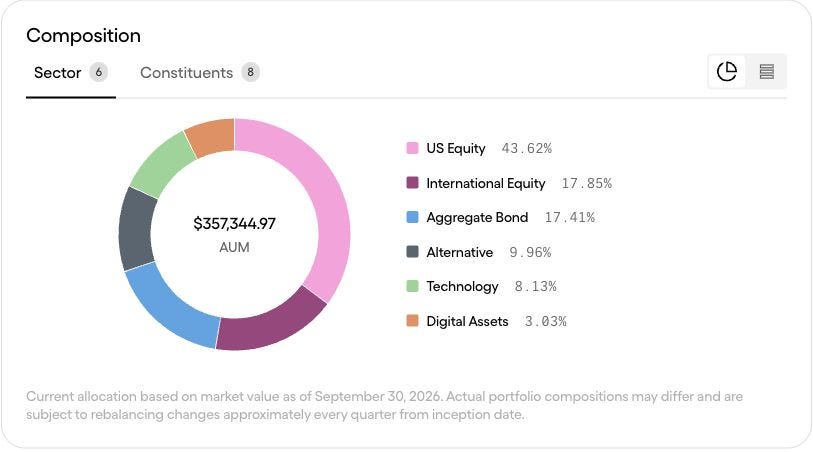
Ondo rebalances the portfolio quarterly and reinvests income after applicable withholding taxes. For this service, it charges 0.49% annually, waived for the first three months; transaction and network costs apply separately. Investors hold a tracker certificate that follows the basket’s economic performance, without owning the underlying ETF shares.
Reaching investors
For asset managers, these products offer a way to reach investors through the crypto accounts they already use. In a BlackRock podcast with Coinbase, Robbie Mitchnick described users whose crypto-platform account may be their only financial account. Offering diversified portfolios there could help those investors move beyond selecting individual assets.
Whether that attracts enough demand is still uncertain. Brian Huang, co-founder of competing portfolio platform Glider, told Blockstories:
“Traditional investors already have easy access to stocks and ETFs through traditional brokers, while crypto-native investors tend to seek higher-yielding or more differentiated opportunities. Recreating familiar exposure onchain therefore does not attract either group.
There is also a structural challenge when a portfolio is wrapped into a new token, as that token needs its own liquidity for secondary trading and DeFi integrations.”
Trading and access
Tokens can trade outside US market hours, but investors buying or redeeming directly with Ondo must first complete onboarding. These transactions are generally available between 9:30 a.m. and 3:45 p.m. Eastern Time on regular US trading days. The products are unavailable to US persons, with access in the EEA and UK restricted to qualified investors.
These trading-hour differences would also matter if the tokens were used as collateral. As DeFi commentator Nikos argued, lenders would need to account for price gaps when stock markets reopen and the difficulty of redeeming collateral during liquidations.
What’s next
Ondo plans to introduce more asset types and portfolios whose allocations can change over time. Over time, these portfolios could combine familiar investments with lending and hedging strategies. Today’s products already take portfolio construction and rebalancing off the investor’s hands. Further uses will depend on demand, trading liquidity and support from other financial applications.
Swift Connects Tokenized Deposits
Swift’s shared blockchain ledger moved from initial readiness in July to live bank-to-bank testing in August. It connects banks’ tokenized-deposit systems and coordinates payment obligations, while final settlement continues through existing infrastructure.
First live transactions
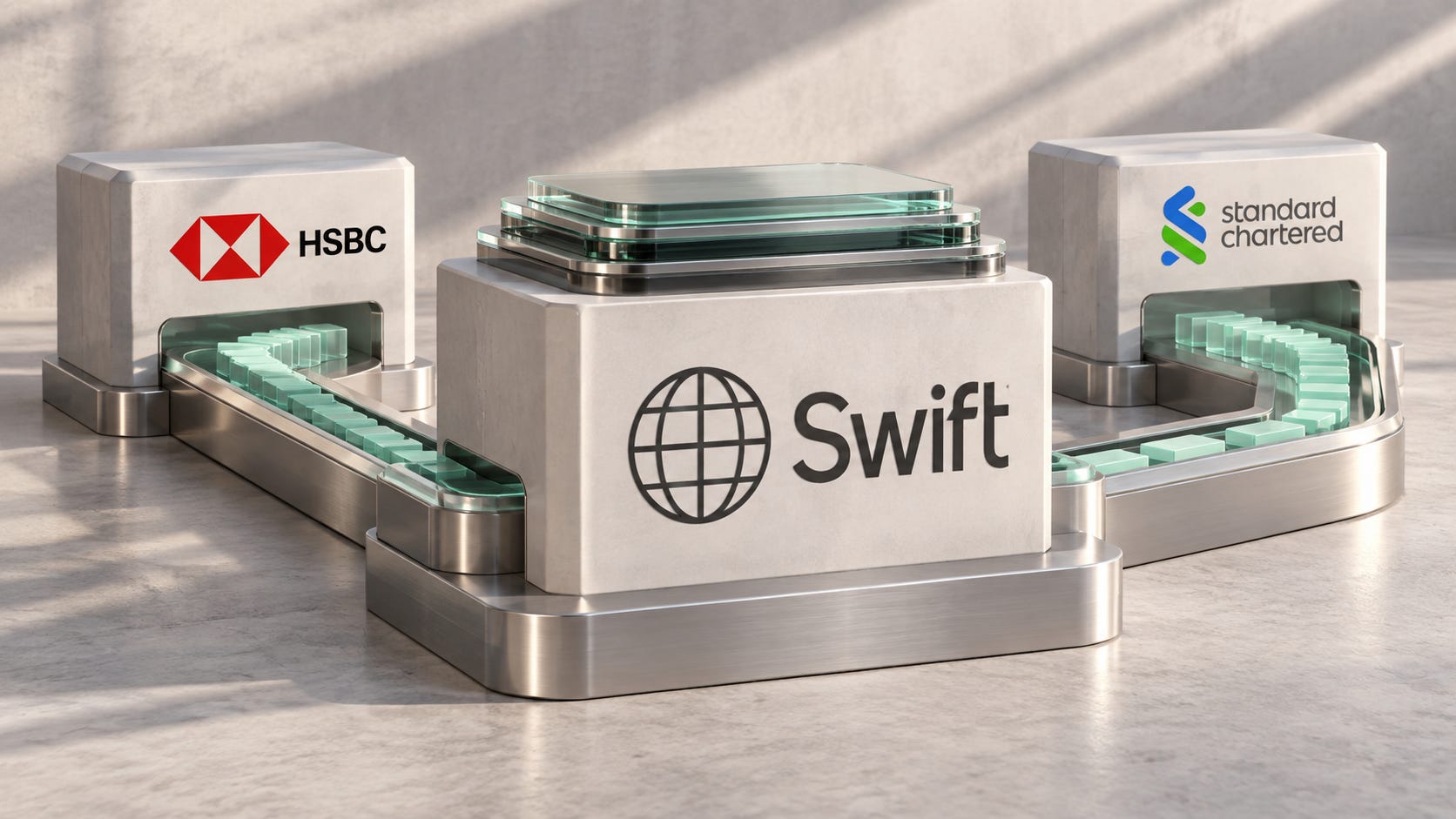
On July 9, Swift announced initial readiness, with 17 banks across six continents preparing pilots. Standard Chartered and HSBC announced the first live cross-border transaction on August 19. UOB and HSBC followed on August 26, reporting transactions in Hong Kong dollars.
How the banks connect
A tokenized deposit is a bank deposit represented on programmable infrastructure. It remains a claim against the issuing bank. Moving money between institutions therefore requires agreement on the obligations created and how they will be settled. Swift’s ledger provides common infrastructure for that coordination, while participating banks retain their own deposit systems.
In the UOB–HSBC transactions, payment obligations were recorded on each bank’s tokenized-deposit infrastructure. Swift’s ledger matched and netted them before final settlement through existing systems. The design allows banks to make funds available to customers before that settlement completes. Swift already reports that 75% of payments reach the beneficiary bank within ten minutes; arrival at the bank and availability in the customer’s account are different milestones.
Moving cash outside banking hours
Companies could gain greater flexibility to move cash between banks outside normal operating hours. An existing HSBC service illustrates the demand: in a May interview with The Asian Banker, Lewis Sun described a client that previously funded its European payout account every Friday for the weekend. Tokenized deposits allowed it to replenish the account according to actual demand, reducing the need for precautionary funding. That case involved HSBC’s own service and preceded the Swift transactions.
In the August transaction announcement, Sun, HSBC’s Head of Digital Currencies, explained the objective of extending this capability across institutions:
“For corporates, this is about solving real-world challenges, such as moving liquidity around the world, across financial institutions, increasing cash visibility and reducing the complexities sometimes associated with traditional cross-border transactions.”
Transfers within a bank can already operate around the clock using conventional systems. Standard Chartered’s Mark Willis identifies tokenization’s additional uses in exchanging deposits between banks, paying for tokenized assets and programming linked transactions. One example is delivery-versus-payment, where a security and its payment change hands together. These applications extend beyond the payment coordination demonstrated in Swift’s initial transactions.
Liquidity and counterparty risk
If a receiving bank credits its customer before interbank settlement, it needs funding and protection against the sending bank failing to pay. Possible arrangements include prefunding, reserved liquidity, collateral and credit limits. These are design choices, rather than evidence that Swift has implemented a particular model across all participants. In a July interview, Willis emphasized the legal relationships and counterparty-risk arrangements required to connect banks.
Connecting bank ledgers leaves several practical obstacles to wider adoption. Payments involving currency conversion still require someone to supply the destination currency at an acceptable price, including in less liquid markets. Enough banks and payment providers must also support compatible systems. Participation depends on commercial incentives: institutions earning revenue from correspondent services and liquidity provision may see less benefit in adopting a model that could reduce those earnings.
Other settlement models
The BIS’s Project Agorá combines tokenized commercial-bank deposits with tokenized central-bank reserves on a shared programmable platform. It enables atomic settlement, meaning linked payment legs complete together. The BIS reports that July testing involved 28 financial institutions and central banks, with transactions totaling approximately CHF 800,000. This remained controlled testing, but demonstrated an alternative to Swift’s initial approach of coordinating obligations before external settlement.
Central clearing is another option. In a reported test involving five Spanish banks, ioBuilders used a model in which one institution cleared participants’ exposures. This reduces the need for every bank to accept every other bank’s deposits directly.
Connecting more banks
Integration, compliance, monitoring, investigations and customer support also affect the business case. In a May article for Trade Treasury Payments, Sun argued that these costs must be included when assessing digital money. Onchain transaction fees alone do not capture the cost of delivering a regulated payment service.
Existing Swift membership does not automatically make a bank ready to use the ledger. Swift’s Head of Innovation Nick Kerigan explains that participants need compatible tokenized-deposit capabilities.
Since the summer pilots, IBM has announced a beta integration connecting its Digital Asset Haven platform to Swift’s ledger. Participating institutions can instruct tokenized-deposit transactions using standard ISO 20022 payment messages and existing operational processes. IBM reports successful tests with financial institutions, providing a practical example of how banks can connect the ledger to their established workflows.
Citi’s global payments head Debopama Sen described integration as manageable given the bank’s existing infrastructure and experience with Swift. For Citi, the harder challenge is getting enough other banks to join.
What remains unproven
The initial transactions demonstrated live connections between participating banks. They do not establish how the model performs at commercial scale. Open questions include the funding required between customer credit and final settlement, the cost of operating across institutions and currencies, and the level of recurring customer demand.
Cloudflare Builds a Checkout for AI
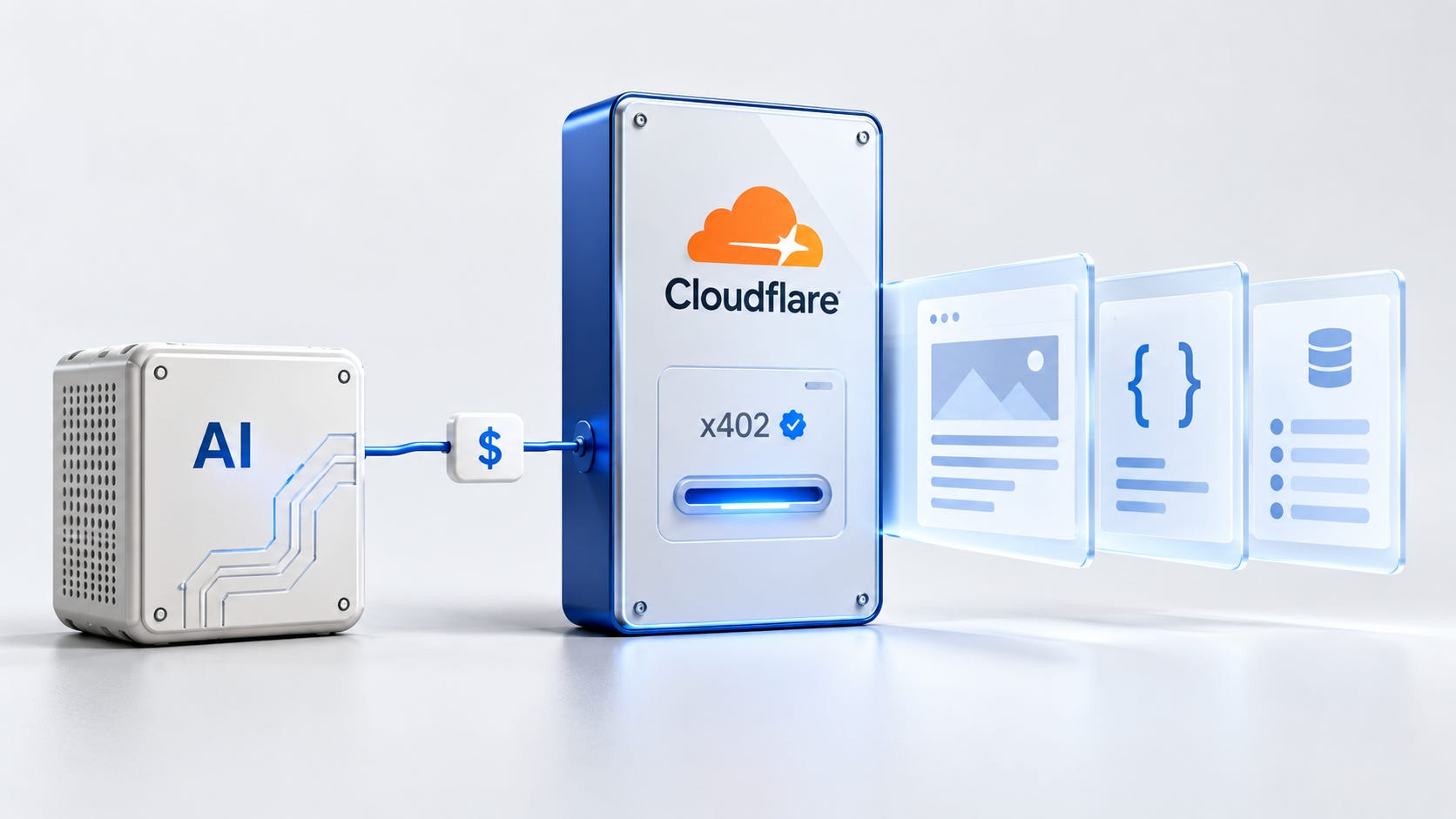
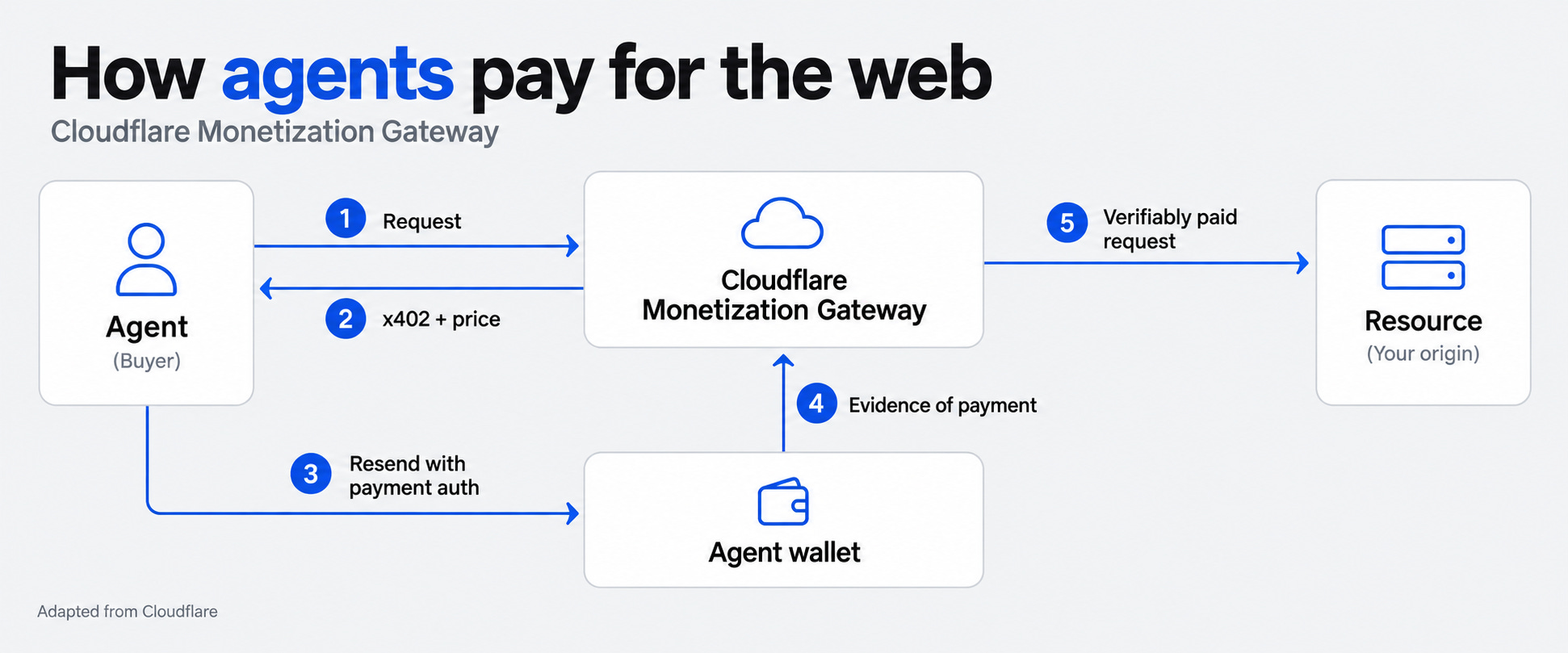
Cloudflare, the internet infrastructure provider, announced its Monetization Gateway on July 1. The planned service would let businesses charge AI agents for access to webpages, datasets and software services, with stablecoin payments through x402, a protocol that adds payment instructions to web requests. In August, the company announced agent wallets with spending controls. The two products would let businesses price digital resources and agents purchase them within a user’s spending limits.
Why the web needs a different payment model
AI agents can retrieve information without bringing readers to the sites that produced it. In a Bankless interview, Cloudflare CEO Matthew Prince argued that advertising and subscriptions are poorly suited to this pattern of consumption: agents do not click on ads, while one subscription can give them access to large amounts of content. Charging for individual requests would compensate publishers and service providers directly for that usage.
How an agent pays
A website sets a price for a resource. When an agent requests it, the server returns an HTTP 402 payment requirement. The agent can then submit the required payment authorization, which is checked before access is granted. Cloudflare plans to handle these rules and verification within its existing network, reducing the integration work for website owners.
Visa and Artemis distinguish small software-to-software payments, such as buying data or computing capacity, from larger purchases delegated by people. Stablecoins can suit the former, where fixed transaction fees are disproportionately expensive. Cards remain relevant for purchases such as flights and subscriptions. Agentic commerce can use both.
A paywall in practice
AllUnity and crypto publisher BTC-ECHO announced a stablecoin-based paywall project in June. In a July interview with Blaupause, AllUnity CTO and COO Peter Grosskopf described a running pilot charging agents one to two cents per article. He sees an advantage in removing the need for people to approve every small purchase: agents could buy individual resources within an agreed budget. The pilot is separate from Cloudflare’s product plans. AllUnity offered to cover setup costs for pilot partners, leaving open whether publishers could operate such a service profitably.
Wallets and spending controls
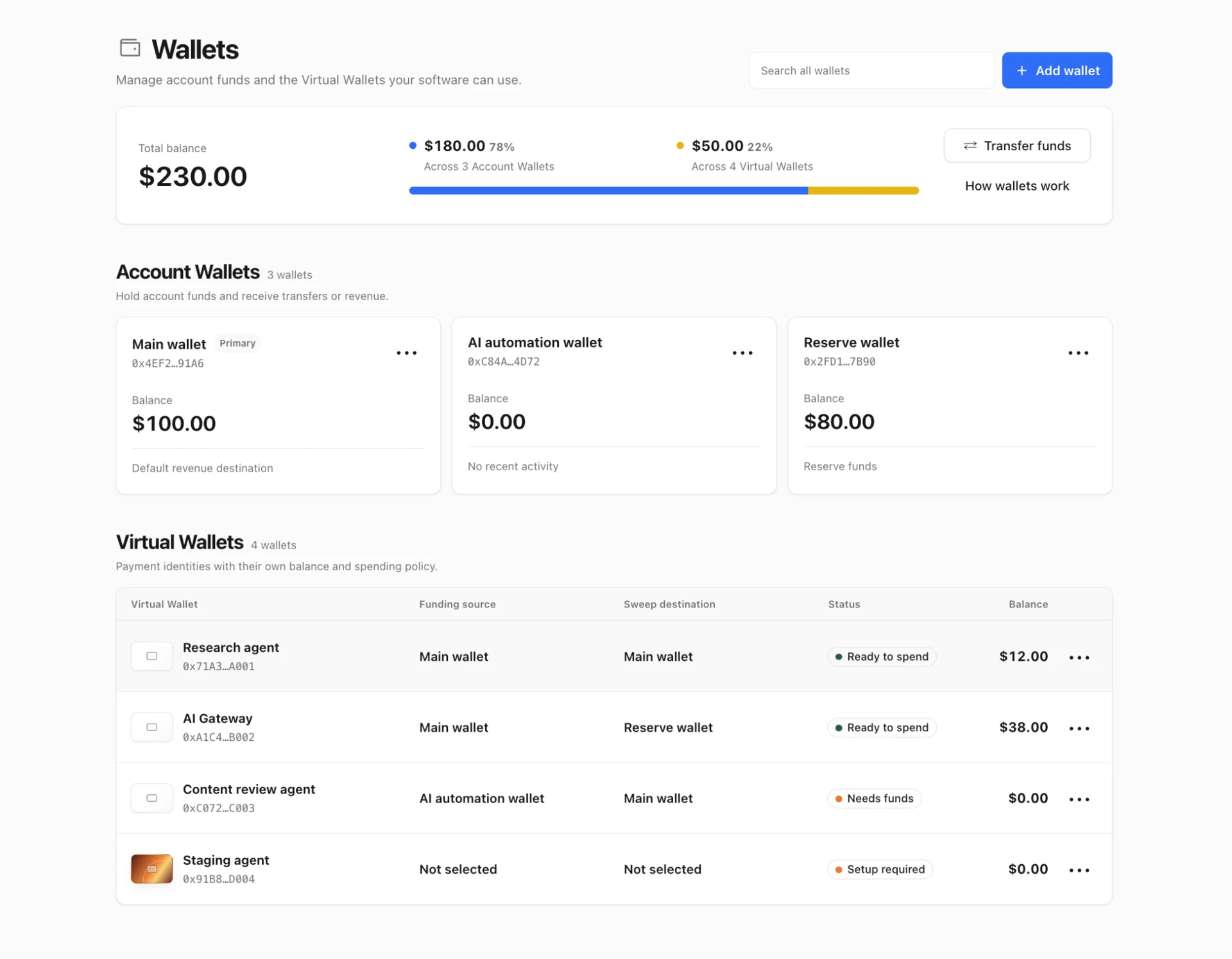
On August 4, Cloudflare announced Wallets, addressing the buyer side of the market. Human-controlled Account Wallets would allocate funds to Virtual Wallets operated by agents. Planned controls include allowances, permitted merchants and maximum transaction sizes. Persistent wallet identities could also help sellers recognize an organization behind repeated requests.
Cloudflare currently offers wallet-name reservations. Payment functionality is still forthcoming, and the Gateway remains on a waitlist. Developers can already use integrations released in July to add Machine Payments Protocol (MPP) support to agent frameworks, including Cloudflare Agents.
BNY’s Bana Akkad Azhari advocates starting with narrowly defined, supervised applications, with clear decision boundaries and human intervention. Grosskopf makes a related point in Becoming CTO Secrets: spending permissions need to be enforced by software. A technically valid payment can still be an unwanted expense.
Businesses also need to check what agents accomplish with those funds. At Stripe Sessions, Alchemy CTO Guillaume Poncin argued that agents need a verification step to establish whether they completed their assigned tasks.
What the early numbers show
Early customers are often professionals buying inputs for research, sales and development, according to Merit Systems product engineer Lucas Shin. By mid-July, Merit had generated more than $40,000 in revenue across approximately 765,000 transactions since the start of the year from services it had built, according to Shin’s own account. To attract paying agents, he argues, services need documentation that software can interpret, suitable pricing and payment options, and a way to recognize returning customers.
Ordinary scripts can use x402 and leave the same onchain record as an AI agent, making adoption difficult to measure. An analysis by TRM Labs filtered its dataset for self-payments and concentrated activity, then applied behavioral tests to the remaining commercial volume. Its models classified between 0.6% and 7.5% as potentially agentic. The estimate is sensitive to those assumptions and may miss agents repeatedly buying from a single service. Total payment volume therefore cannot, by itself, establish how much demand comes from AI agents.
What still needs to work
In comments published by Blockstories, Grosskopf outlined the commercial requirements he believes must be addressed alongside payments:
“But widespread adoption will require more than payment facilitation and a growing supply side. Several parts of the agentic commerce stack still need to mature before businesses can adopt it at scale.
Discovery: agents need a reliable way to find available products and services and decide which merchants to trust.
Checkout: once an agent has decided what to buy, businesses need a purchase flow built for agents, including the ability to bundle multiple purchases into a single payment.
Payout: businesses need a way to move the stablecoins they receive into the bank accounts and currencies they actually use in the real world.
That last point matters especially in Europe, and not only for agentic payments. Stablecoin payment activity is still largely denominated in U.S. dollars, while local businesses usually want to be paid in local currencies. For agentic commerce to scale, the stablecoin layer has to reflect the currencies in which businesses report and manage revenues.”
Token Funding: A New Route to US Investors

On August 18, the US Securities and Exchange Commission proposed Regulation Crypto Assets, a dedicated framework for financing crypto projects through token offerings. It would create two routes to raise capital, including from retail investors, and establish conditions under which the investment contract associated with a token could end. The framework remains a proposal.
The distinction between token and contract is central. The rules would cover investment contracts involving tokens that are not themselves securities. They would not provide a new exemption for tokenized shares or fund interests. The SEC is addressing how a team can accept investors’ money to develop a network or application before that work is complete.
In his announcement, SEC Chairman Paul Atkins explained the objective:
“Today’s proposal sits at the center of this Commission’s capital formation agenda and is essential to providing a framework for crypto asset fundraising. It is the Commission’s answer to the question that has puzzled innovators since the birth of the blockchain: ‘How can I raise capital to develop a crypto asset while I am still working to develop the network where it will be used?’”
Two routes to capital
The SEC’s fact sheet sets out the proposed routes:
Startup exemption: A one-time exemption for up to $5 million over a four-year period. Issuers would file a notice, publish information about the project, token, team and development commitments, and keep required disclosures current. Financial statements would not be required under this route.
Fundraising exemption: Up to $20 million under Tier 1 or $75 million under Tier 2 in each twelve-month period. Offerings would require SEC qualification, financial statements and ongoing reporting. Tier 2 would also require audited financial statements.
Both routes would retain federal antifraud and antimanipulation protections. The larger route would impose additional issuer-eligibility and investor conditions. These are exemptions from full Securities Act registration, with obligations of their own.
When the investment contract ends
The proposed safe harbor connects the contract’s endpoint to the issuer’s commitments. An issuer would need to have completed or permanently ceased its promised essential managerial efforts, neither make nor intend to make new such promises, and file a public certification with supporting analysis. Ordinary maintenance and improvements could continue after the relevant commitments had been fulfilled and the network was functional.
The filing would not erase earlier liability or prevent a challenge to whether the conditions were met. Private parties could still argue that an investment contract exists. For founders, the promises made when raising money would therefore remain consequential well beyond the sale.
Issuance needs a functioning market
The proposal would remove offering-related resale restrictions, subject to other applicable rules. It would not create corresponding exemptions for exchanges, brokers or dealers. A token could therefore become eligible for resale while the infrastructure needed to trade it remained subject to separate regulatory requirements.
For projects that depend on accessible secondary markets, this leaves an important practical question unresolved. Circulation and use can be fundamental to a network token’s purpose. Permission to issue and resell a token does not itself establish a market with buyers, reliable execution and sufficient liquidity.
Who would use it?
Public token sales could provide a financing route for smaller, community-driven projects whose economics are unlikely to attract conventional venture capital. They could also allow prospective users to participate in funding a network before it is fully developed.
The fit is less obvious for centrally managed applications and revenue-generating businesses. For these companies, a clearer route to issuing tokens would still leave a basic question: what role does the token serve, and why would investors choose it over equity? The proposed framework would expand the available financing options. Demand would depend on the projects using them and the economic interests offered to investors.
Where the value accrues
For investors, the financing instrument also determines which economic interests they acquire. Balder Bomans, CIO of Maven 11 Capital, describes the tension in an interview:
“While the market has recently been shifting toward pure equity, the dual equity-plus-token structure remains the default for many crypto startups. Pure token-based raises, meanwhile, have become marginal. That partly reflects a broader change in the market itself: crypto-native projects are increasingly giving way to more mature, revenue-generating businesses that look and operate more like traditional companies.
The dual structure, however, creates a persistent problem for public-market investors. It is often unclear where the economic value is meant to accrue: to the token, to the equity, or to both.”
The proposed disclosures could help investors examine those arrangements, but would not grant tokenholders shareholder rights. Commissioner Hester Peirce explicitly invited ideas on enabling tokenholders to share in the growth and value of the enterprise building a network. A clearer issuance process would leave that underlying investment question open.
Competition for venture capital?
For companies that can already attract private capital, the choice would depend partly on distribution and reporting obligations. Private financing would retain advantages for projects seeking large rounds without the proposed public reporting requirements. Reg Crypto’s distinctive appeal would be access to a broader group of prospective users and investors, including non-accredited buyers. Projects could use public token offerings alongside private rounds, making the new framework a potential complement to venture financing.
Broader participation would also raise questions about who carries development risk. Lee Reiners of Duke University argues that early investors could benefit from wider public liquidity while retail buyers absorb more of that risk. Allocations, insider sales and investor protections would therefore matter alongside the amount of capital a project could raise.
Some VC funds would also face constraints as buyers. Funds whose advisers rely on the specific US venture-capital adviser exemption would generally count these investment contracts against their 20% allowance for non-qualifying investments. A clearer offering regime would not automatically make tokens suitable for every fund or permitted by every mandate.
The cost of raising publicly
Access to a wider investor base would come with ongoing obligations. Disclosure, financial reporting and, for Tier 2, audits would create recurring costs. The securities-law exemption would also leave separate accounting and tax questions to resolve.
For international groups, the cost could extend to restructuring. Transferring IP, tokens or contractual rights, moving management, and changing intercompany arrangements can affect taxation in several jurisdictions. Those consequences would depend on the transaction and existing structure. The proposal would not introduce a separate tax regime for token-sale proceeds.
A reason to move to the US?
The larger fundraising route would require substantive US ties. These include US incorporation, a majority of executive officers or directors who are US citizens or residents, more than half the issuer’s assets located in the US, and principally US-based administration. The startup route does not contain the same tests.
For some international groups, adding an eligible US issuer could allow access to the larger route while retaining other entities abroad. Whether that would be worthwhile would depend on investor demand, tax treatment, reporting costs and the operational changes needed to qualify. A Delaware registration alone would not satisfy the proposed conditions, and the availability of an exemption would not by itself establish a business case for relocation.
What this means for Europe
For Europe, the competitive question would center on how regulation works in practice. Durable rules could be an advantage for founders planning over several years, provided requirements are workable and authorization processes move quickly enough to support their businesses. Access to investors and the cost of compliance would remain part of that decision.
The comparison also has legal limits. MiCA and the proposed US exemptions address different questions. Access to a US offering exemption would not settle an issuer’s obligations for an EU offering. Groups seeking investors in both markets would still need to assess each regime separately.
The SEC is accepting comments until October 20. Its final rules may differ from the proposal. The commercial test would follow: whether projects choose the new routes, investors fund them, and tokens reach markets where their rights and economics are understood.
Key Events of the Last Quarter
Eurosystem launches Pontes for tokenized securities settlement
The Eurosystem launched Pontes, enabling wholesale transactions in tokenized assets to settle in central bank money. An initial group of banks and market infrastructures completed onboarding, with additional participants, services and longer operating hours planned as the system develops.
Visa introduces a stablecoin platform for financial institutions
Visa introduced the Visa Stablecoin Platform, allowing financial institutions and fintechs to mint, redeem, hold and transfer stablecoins, beginning with Open USD. Initially available for beta testing with selected clients, it combines wallet infrastructure and approval controls with connections to Visa’s payment and settlement services.
Securitize lists on the NYSE and brings its own shares onchain
Securitize began trading on the NYSE under the ticker SECZ following its merger with Cantor Equity Partners II. The company also tokenized its own common stock at listing, applying its infrastructure to the shares of a publicly traded company.
FASB proposes guidance on classifying stablecoins as cash equivalents
The FASB’s proposed accounting update would clarify when certain stablecoins meet the existing definition of cash equivalents. Its examples consider direct redemption rights and reserve backing. The proposal also introduces additional disclosure requirements, with public comments due by November 19.
Bitget reports a $388 million security breach
Bitget reported approximately $388 million in unauthorized transfers from its exchange wallet infrastructure on September 24. Bitcoin and Ether withdrawals have since resumed on supported networks as services are restored in stages. Independent forensic investigations and efforts to trace and recover the affected assets remain ongoing.
What We’ve Been Reading
Institutional Crypto Adoption Report (Bitwise)
None of the crypto holders in Bitwise’s interviews with 15 institutions reported cutting their allocation during the roughly 50% market decline from October 2025 to April 2026. Bitcoin was their common holding, while Ethereum and Solana positions depended more on evidence that adoption would create value for tokenholders.
TradFi doesn’t want DeFi. It wants blockchains. (a16z crypto)
Institutions want blockchain features that lower costs and improve settlement while preserving control over customers and operations, Christian Crowley and Pyrs Carvolth argue. Their conclusion is that institutional infrastructure and open DeFi require different products, sales processes and measures of success.
5 charts: How crypto cards are driving stablecoin spend (a16z crypto)
Tracked crypto-card spending reached $759 million in July, roughly 2.5 times its level a year earlier. a16z crypto’s charts show stablecoins reaching everyday purchases through existing card networks, with dollar-backed tokens dominating settlement. The dataset combines onchain observations with issuer-reported spending.
What Kalshi’s Weather Markets Reveal About Forecasting (Tarek Mansour)
Kalshi co-founder Tarek Mansour discusses a new preprint by Alexander W. Crosier finding that Kalshi’s next-day temperature predictions had roughly 10% lower forecast error than the best individual public weather forecast across seven US cities. The findings offer evidence that prediction markets can add useful information to existing weather forecasts.
Who’s Actually Paying? Measuring AI Agent Payments Onchain (TRM Labs)
TRM Labs estimates that AI agents account for only 0.6% to 7.5% of the x402 payment value it classified as likely commerce. High payment volumes alone therefore do not establish broad agent adoption, although the methodology may miss agents that repeatedly buy from a single service.
The Conservation of MEV (Greenfield Capital)
Greenfield argues that the economic advantage of transaction priority persists even when public MEV markets disappear. Across Ethereum, Canton, Hyperliquid and traditional finance, different designs change who controls execution, whether the price of priority is visible and who receives the proceeds.
The Cryptographic World Computer (Vitalik Buterin)
Vitalik Buterin argues that cryptographic verification could let decentralized networks divide computation more efficiently, making decentralization a source of performance as well as security. His proposed Ethereum architecture combines the blockchain with offchain computation and privacy tools, with application design increasingly determining costs.
Thanks for reading Blockwall Insights! Subscribe for free to receive new posts and support our work.
Disclaimer
To avoid any misinterpretation, nothing in this blog should be considered as an offer to sell or a solicitation of interest to purchase any securities advised by Blockwall, its affiliates or its representatives. Under no circumstances should anything herein be interpreted as fund marketing materials for prospective investors considering an investment in any Blockwall fund. None of the data and information constitutes general or personalized investment advice and only represents the personal opinion of the author. The author and/or Blockwall may directly or indirectly be exposed to the mentioned assets/investments. For further information please view the full Disclaimer by clicking the button below.
This work is licensed under the Creative Commons Attribution – No Derivatives 4.0 International License. CC BY-ND 4.0 Legal Code | Creative Commons