

AI is no longer confined to screens and software. As it merges with robotics, machines are gaining the ability to perceive the world, interpret changing conditions, and act in real time. This shift toward intelligent physical systems (aka Physical AI) is beginning to reshape industries and holds potential to influence everyday life at home as the technology matures.
Innovation in robotics is surging like never before. Figure recently introduced their Figure 03 humanoid robot designed for both household and commercial applications. It can do some household tasks like folding clothes and loading a dishwasher, but it’s not perfect yet. Tesla is operating Optimus humanoid robots in limited internal pilot programs on factory floors. Autonomous drones and legged robots are increasingly explored for hazardous inspection tasks, such as inspecting power grids. At the same time, companies like Unitree Robotics and tactile (sense of touch) technologies like FlexiTac are aiming to navigate messy homes, staying safe around pets and children, and assisting with everyday chores. Intelligent robots, once ready, will emphasize general intelligence and situational awareness, recognizing, for example, that a spilled glass of water needs attention without explicit instruction.
Investors are allocating significant capital toward the technology stack expected to underpin the next generation of robotics hardware. In January 2026, Skild AI raised $1.4 billion in a Series C round at a valuation of $14 billion to scale its universal robotic foundation model, while Figure AI raised more than $1 billion in its 2025 Series C round at a post-money valuation of $39 billion to expand humanoid manufacturing capacity and industrial deployments. Apptronik extended its Series A to $935 million, and NEURA Robotics added €120 million in its Series B financing, highlighting a growing consensus that Physical AI is emerging as a strategic foundation for both consumer and industrial robotics.
Are we at the inflection point for intelligent robotics adoption?
The acceleration we are seeing in this area is the result of a convergence of technologies. For decades, the building blocks were being developed separately i.e., advanced AI algorithms, high-fidelity sensors, manipulators, and real-time control systems. Only recently have these pieces started to fit together, enabling robots that can perceive, reason, and act effectively in real-world environments. Here’s a breakdown of the key categories driving this “Robotics Inflection Point”:
The Economics: Hardware is finally commoditized. In the past, robots were expensive because every part was custom-made. Now, they are benefiting from the Consumer Electronics and EV (Electric Vehicle) supply chains.
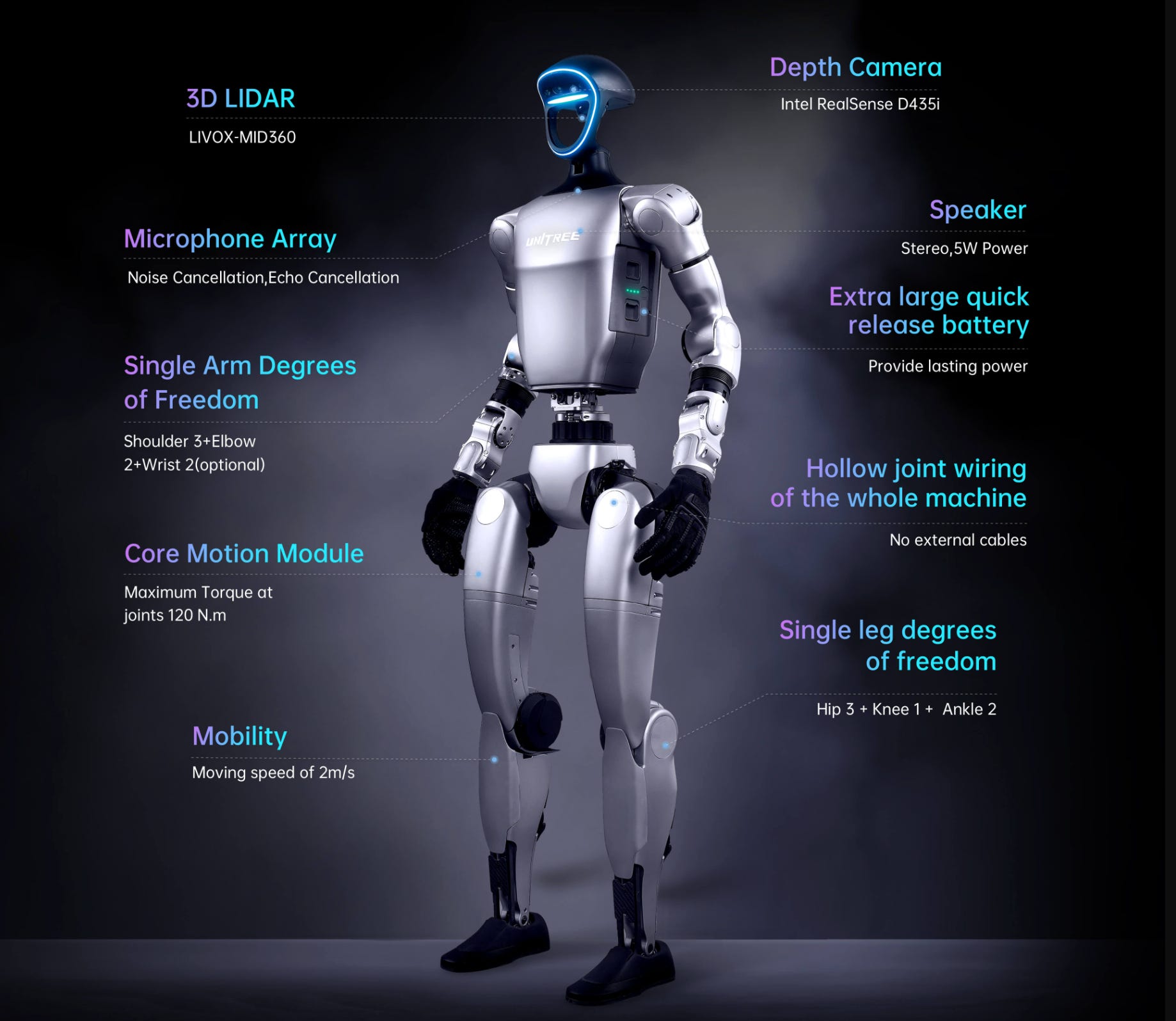
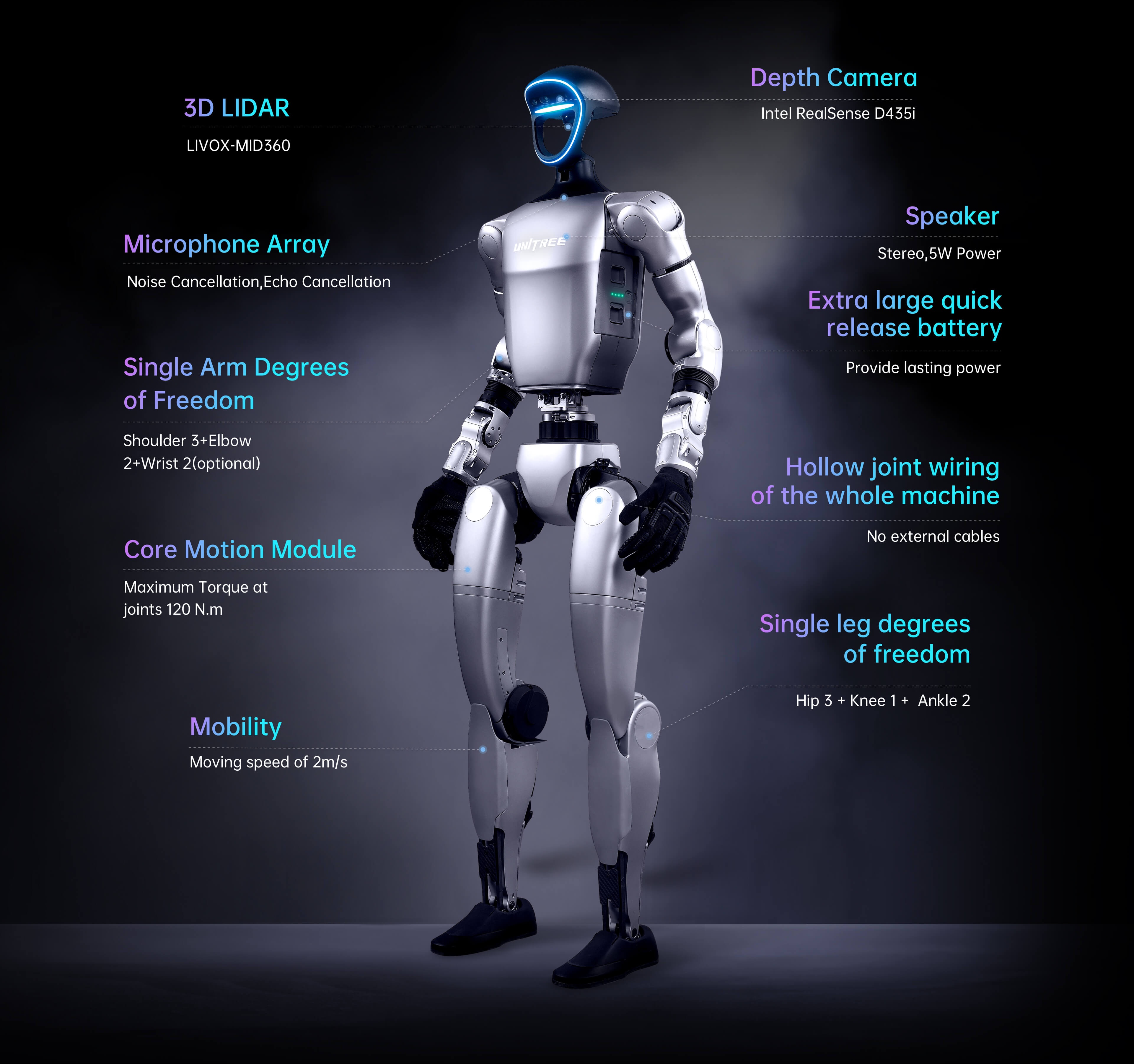
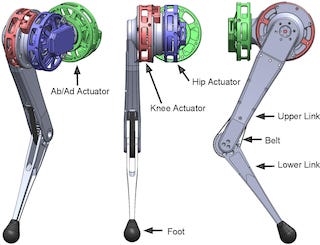
Actuators: High-torque humanoid actuators were historically expensive, often costing $1,000+ per joint in low-volume industrial systems. New vertically integrated designs from companies such as Tesla and Unitree Robotics are pushing some actuator component costs into the hundreds of dollars.
Sensors: The cost of LIDAR and depth cameras has dropped dramatically over the past decade. High-end units that once cost around $10,000 can now be found for a few hundred dollars, thanks to advances in solid-state designs, mass production, and adoption in automotive and mobile devices.
Batteries: Massive global investment in electric vehicles has driven down the cost of high‑density lithium‑ion batteries and improved their reliability, allowing many robots to operate for 2–4 hours on a single charge.
Edge Computing: Robots must process information locally because real-time control tasks, like balancing or catching objects, cannot tolerate network delays. Edge chips like NVIDIA’s Jetson Thor are designed to run AI inference on-board, processing multiple sensor streams simultaneously. This lets robots process and track their environment locally, enabling rapid responses to changing conditions without depending on a network connection.
The “Brain” Breakthrough (AI Models): This is the biggest change. We moved from “if/then” programming to “World Models”. A world model is an AI model that watches videos and learns how the real world works. Instead of programming a robot to “turn the doorknob,” we show it 10,000 videos of operating doors. The AI builds a mental map of how physics works by simply observing the videos. This allows the robots to develop physical intuition and mentally simulate a scenario before taking an action. If a model can learn how objects move and react by watching videos, it can later use that learning to handle specific tasks like finding its way in a warehouse or folding laundry. Google Deepmind Genie 3 and NVIDIA Cosmos are two leading examples of this new class of world models.
Bottomline: Cheap Robotics Hardware + Powerful Chips + AI Models = Democratisation of Intelligent Robotics.
While these machines are becoming more intelligent, the cost continues to decline e.g. Noetix Bumi (USD 1400) robot now costs approximately same as an iPhone 17 Pro Max. The convergence of falling hardware costs, better AI chips, and more capable world models is creating more accessible intelligent robotics and expanding development beyond deep‑tech labs.
If the ChatGPT moment for robotics arrives in the near future, we will most likely see industrial and logistics deployments first before true household humanoids. While many challenges remain before intelligent robotics is truly democratized, a rational optimist would recognize that the trends are pointing toward a future where widespread adoption is increasingly possible.
Major software breakthroughs usually follow hardware breakthroughs. Instagram and TikTok only became possible once the necessary hardware existed. If intelligent robotics hardware reaches mass availability in the near future, it raises an interesting question: will robotic apps be the next wave?
What are the current challenges slowing down the momentum?
Robotics Training Data: This is the ultimate bottleneck for general-purpose intelligent robotics. Unlike text-based AI, which can scrape the entire internet, robots need real-world experience, feeling forces, balancing, and interacting with objects, etc. Collecting this kind of data is slow, expensive, and labor-intensive.
The “Physicality” Problem: Watching videos can’t fully teach a robot how to manipulate objects or move safely, it must experience forces and contact firsthand. Teleoperation, where a human guides the robot in real time, captures both intent and force and serves as the gold standard for data collection. Producing hundreds of hours of high-quality data, like Unitree’s 340-hour release, requires a human operator present the entire time, making it far less scalable than digital data collection. Here is a video from the dataset showing a teleoperation training where a robot is sorting fruits by placing the watermelon in the pink plate, the banana in the yellow plate, and the avocado in the green plate.
Sim-to-Real Gap: Simulation can generate vast amounts of data cheaply, but robots often fail when transferring skills to the real world due to unmodeled physics or unpredictable environments.
Onchain Machine Economies
The combination of blockchain and robotics offers a practical solution to robotics current challenges. Token incentives can help coordinate millions of robots and reward contributors who remotely operate devices or share sensor data. Each interaction becomes a valuable data asset, building a fast-growing, community-owned robotics dataset that scales beyond any single company.
Tokenizing the Data Collection
Robotics data is extremely valuable, but real-world sensory and interaction data is scarce, making it a rare resource for AI training. Large companies collect massive amounts of driving and industrial data through their fleets, giving them a scale advantage that independent developers generally cannot match.
Decentralised Physical AI aims to change this by allowing users to remotely pilot robots or contribute sensor data from their devices, with token incentives for valuable contributions. Instead of a single company hiring hundreds of operators, a decentralized network can coordinate thousands of hobbyists globally. Contributors who help a robot navigate tricky surfaces or unusual conditions can upload that data and earn rewards. While these platforms are still early, they point toward a future where robotics data could be shared more broadly, reducing the dominance of a few large corporations.
Robots as Economic Agents
In a Robot-as-a-Service model, intelligent robots themselves could be “tokenized” assets. Each robot (or a fraction of its usage time) could be represented by a digital token, allowing multiple users to own, lease, or share access to it. Payments for the robot’s services, whether delivering packages, performing maintenance, or farming, could be made in tokens or stablecoins directly to the robot’s wallet. This setup enables autonomous revenue generation, where the robot earns for its work, covers its own operational costs like energy or software updates, and distributes profits automatically to token holders. Essentially, a web3 protocol that turns robots into programmable, self-sustaining service providers with transparent and trackable earnings.
Physical AI Market Map
The boundary between digital intelligence and physical action is dissolving as a new wave of intelligent machines learns to navigate and understand the messy reality of our three-dimensional world.
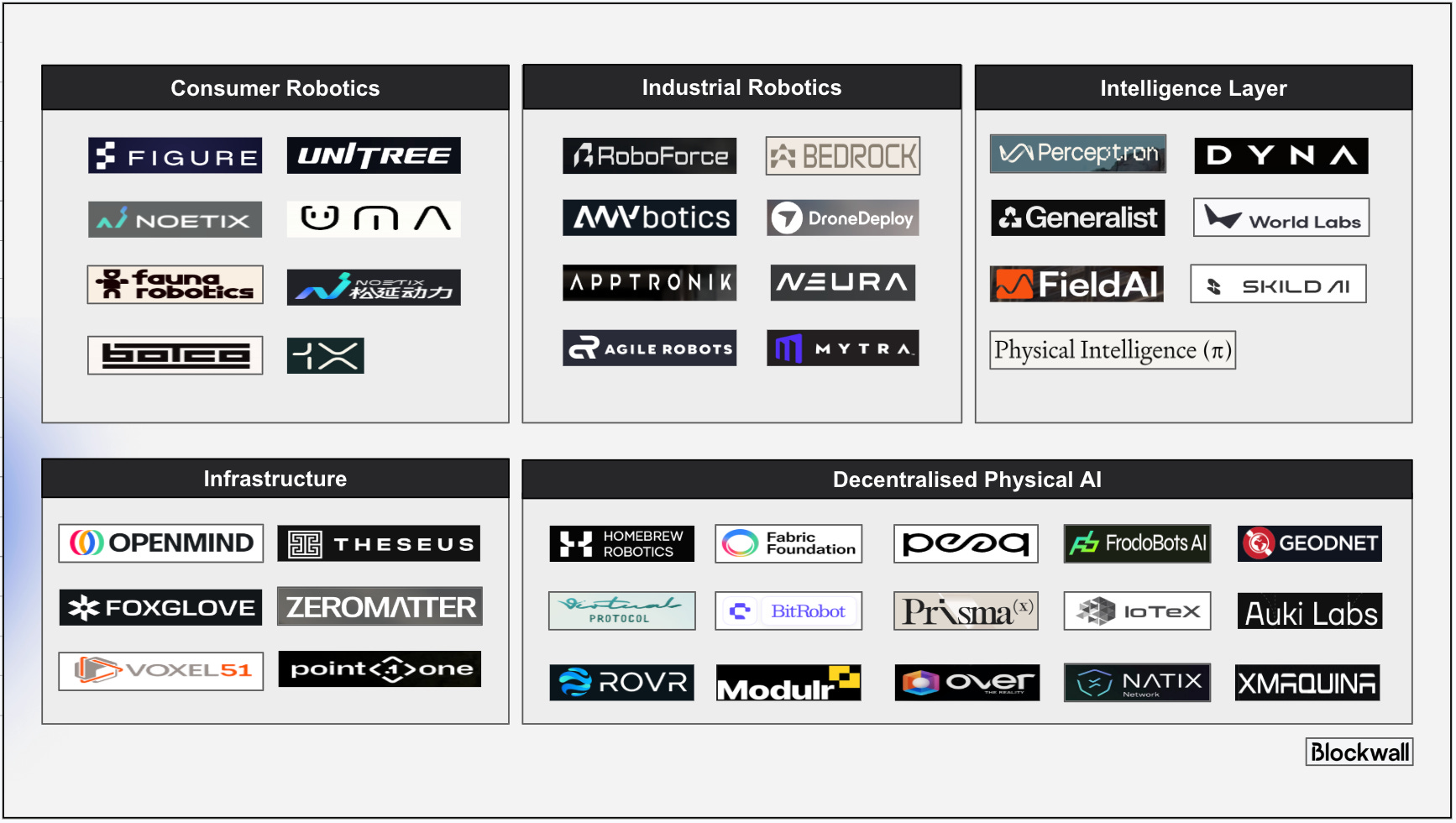
At the heart of this revolution are the AI Models, the sophisticated brains developed by companies like Physical Intelligence, and Skild AI that move beyond static code to provide general-purpose intelligence for various physical forms. These models allow robots to treat agility and mobility as software problems, enabling a single unified “brain” to inhabit multiple types of robotic bodies. This intelligence layer is supported by the simulation platforms and data pipelines, such as those provided by Zeromatter, which allow for the safe training of systems in virtual environments before they are deployed in the real world.
Parallel to the advancement of robotic brains is the rise of Decentralised Physical AI, a sector that moves away from monolithic control toward open, shared ecosystems, e.g., the Fabric Protocol, a decentralized infrastructure network is being built that provides autonomous robots and AI agents with on-chain identities and crypto wallets. It uses cryptographic proofs to verify machine work and coordinate complex tasks through an open, public ledger. The native token powers the network, serving as the primary currency for service fees, operator staking, and governance.
Companies like Auki, Peaq, and IoTeX are building a “machine economy” where robots can share 3D maps, verify data, and even transact autonomously for services. This decentralized approach ensures that the spatial data and coordination layers required for global robotics operations are not controlled by a single corporate gatekeeper but are instead accessible through a transparent and verifiable infrastructure.
The practical application of these technologies aims to transform the industrial and consumer sectors. In the industrial realm, autonomous construction equipment from Bedrock Robotics and warehouse automation from Mytra are redefining labor, while inspection robots from ANYbotics handle routine maintenance in hazardous environments. Simultaneously, the consumer market is nearing a breakthrough in domestic help with the development of humanoids by Figure and Unitree.
The 2030 Vision
Through the lens of a rational optimist, the stage is set for a robotics renaissance. We are witnessing the convergence of four unstoppable forces: hardware costs are plummeting, AI models are scaling in intelligence, edge-compute chips are delivering unprecedented local power, and the “data problem” could be solved at scale by the industrial workforces of global manufacturing hubs. By 2030, this synergy will push Physical AI into every corner of our world, from autonomous farming to the high-stakes demands of firefighting and elder care.
History shows that transformative software innovation usually follows hardware stabilization. We might see the era of “Rented Intelligence” where standardized humanoids will run a standard operating system with an integrated app store. Much like the smartphone revolution before it, the coming years will be defined by a “Robot App Store” where you subscribe to skills rather than buying specialized devices. In this model, the value shifts from the machine itself to the specific "skills" it can execute. You won’t need to buy a specialized French language tutor robot, you will simply download a “French Language Skill App” to your general-purpose humanoid, and it will become a French language teacher. By the end of this decade, the premier holiday gift for the person with resources will no longer be a flagship folding smartphone, but a household companion that actually helps run the home.
This forecast is built on the pillars of my own "rational optimism," but the future is rarely a straight line. I am eager to have these assumptions challenged and want to hear your perspective, especially if it contradicts mine. Do you see a bottleneck I’ve missed, or a different reality for the "App Store" of robotics? Please share your thoughts in the comments; I’m looking forward to being challenged on my assumptions.
Call for Physical AI Startups and Experts: We’re looking to engage with startups and experts in Physical AI domain. If you’re pioneering advancements in this area, we encourage you to reach out. Connect with us on LinkedIn or reach out via email at syed@blockwall.vc
Disclaimer
To avoid any misinterpretation, nothing in this blog should be considered as an offer to sell or a solicitation of interest to purchase any securities advised by Blockwall, its affiliates or its representatives. Under no circumstances should anything herein be interpreted as fund marketing materials for prospective investors considering an investment in any Blockwall fund. None of the data and information constitutes general or personalized investment advice and only represents the personal opinion of the author. The author and/or Blockwall may directly or indirectly be exposed to the mentioned assets/investments. For further information please view the full Disclaimer by clicking the button below.
thanks for this. the onchain machine economy angle is one we've been watching closely too. a lot of VC newsletters we track are starting to connect physical AI and DePIN infrastructure