

At Blockwall, we have long believed that the convergence of traditional private markets and blockchain infrastructure was a question of when, not if. For years, the catalyst remained theoretical: smart contracts can automate complex cash flows, tokenisation can create secondary liquidity where none existed, and on-chain collateral registries can eliminate the opacity that has always been private credit’s original sin. While the thesis was theorically sound, it never got forced into existance.
On March 6, 2026, that forcing function arrived.
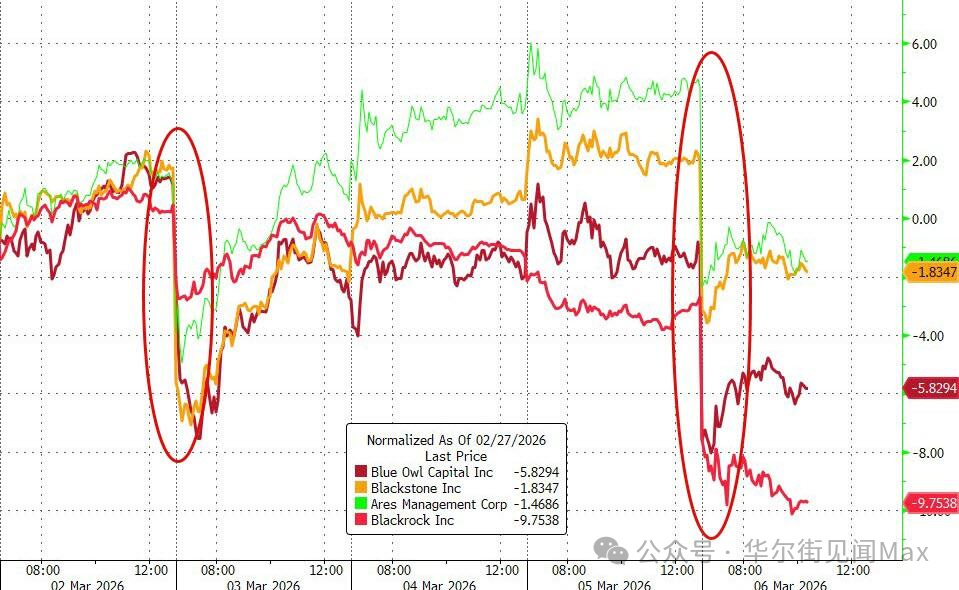
BlackRock announced it was capping withdrawals from its $26 billion HPS Corporate Lending Fund (HLEND) for the first time in the fund’s four-year history. Investors had submitted redemption requests totalling 9.3% of the fund’s net asset value, roughly $1.2 billion. BlackRock honoured only $620 million of those requests, enforcing its contractual 5% quarterly cap and turning away nearly half of the capital seeking the exit. Its stock fell 7% that day. Shares of KKR, Ares, and Apollo fell 5–6% in sympathy. The market, in its blunt way, was repricing a structural risk that had been building quietly for years, and the HLEND gate was the clearest signal yet that distributing private credit to millions of individual investors without fundamentally reimagining its infrastructure was always going to end this way.
The Structural Problem: Selling Illiquidity as Semi-Liquid
Private credit has had an extraordinary run. From roughly $500 billion in assets under management a decade ago, the market has grown to nearly $2 trillion globally, with projections toward $3 trillion by 2028 according to Moody’s. Banks retreated from corporate lending following post-crisis regulation, creating a gap that alternative lenders filled with direct loans to mid-market companies at floating rates and attractive spreads. For institutional investors, the maths were compelling. For individual investors who piled in through non-traded BDCs (Business Development Companies) and interval funds, the product was framed, sometimes loosely, as semi-liquid income. That framing contained a structural tension that good markets tend to ignore until they can’t.
The loans inside HLEND are typically multi-year instruments extended to mid-market companies that cannot access public bond markets, bilateral, lightly reported, and priced by internal models rather than observable market data. When 9.3% of investors simultaneously decide they want their money back, triggered by AI-disruption anxiety, geopolitical volatility, and the cascading psychology of seeing peers head for the exit, the fund faces an impossible task: providing quarterly liquidity from assets that require years to mature.
Academic finance has a name for this: a liquidity transformation problem, as old as banking itself. Brunnermeier and Pedersen’s foundational work on market and funding liquidity showed that when asset illiquidity and funding fragility coincide, the resulting spiral amplifies losses far beyond what underlying fundamentals justify. The private credit BDC structure of 2026 has replicated precisely this tension, dressed in a new wrapper, distributed to a new investor class, and called it semi-liquid.
The Bank for International Settlements (BIS), in a recent bulletin on retail investors in private credit, put the dilemma plainly: BDCs and private credit ETFs marry shares traded in a liquid market to illiquid underlying assets that barely trade, and this mismatch could produce steep, persistent discounts in periods of stress. The BIS also flagged that BDCs’ debt-to-equity ratios, increasingly supported by bank credit lines, have tripled over the past 15 years, raising concerns about potential spillovers from non-bank financial intermediaries back into the banking system. That linkage matters more than it might appear, as the MFS collapse has since demonstrated.
The core problem is not that private credit funds gate withdrawals. A multi-year illiquid loan book was sold, at scale, to investors who believed they could exit within a quarter if the world changed.
HLEND is far from alone. BDC redemptions in the Cliffwater index rose from 1.6% in Q3 2025 to 4.8% in Q4 2025. Blue Owl has permanently closed the redemption window in at least one fund, converting it to a run-off vehicle. Blackstone avoided gating its BCRED only by injecting $400 million of firm and employee capital, an extraordinary step that bought confidence without addressing the underlying mechanics. Goldman Sachs estimates roughly $220 billion sits in retail-focused evergreen private credit funds, about 20% of the industry’s total lending exposure, and these are precisely the vehicles driving the current stress. The IMF’s 2025 Financial Stability Report found that around 40% of private credit borrowers now have negative free cash flow, up from 25% in 2021. Credit quality is quietly deteriorating at the exact moment investors are discovering the limits of the liquidity they thought they had.
The Opacity Problem: When You Can’t See the Collateral
The liquidity mismatch is the headline. The opacity problem is the more dangerous rot underneath, and the collapse of UK mortgage lender Market Financial Solutions (MFS) illustrates just how far it can spread.
MFS, a Mayfair-based bridging lender, was put into administration in late February 2026 amid creditor accusations of double-pledging its collateral. The shortfall in collateral backing loans to MFS entities is estimated at up to £930 million. Multiple lenders, including Barclays, Santander, Jefferies, TPG, and Apollo’s Atlas SP Partners, had extended hundreds of millions to the failed mortgage lender, each believing they held secured positions on real assets. The Bank of England’s (BoE) Prudential Regulation Authority is now grilling lenders, including Barclays, which had accumulated roughly £600 million in exposure to the MFS group, over whether they carried out sufficient risk assessments before extending those loans. The BoE has also announced the world’s first major stress test of the private capital market, the System-Wide Exploratory Scenario, explicitly in response to the back-to-back failures of MFS, Tricolor, and First Brands.
The fraud propagated not just among direct lenders but upstream through the banking system itself, via the credit lines that private credit funds routinely use to manage their own liquidity.
Context matters here too. A large part of MFS’s business involved backing property deals linked to a former land minister in Bangladesh who built a $295 million property portfolio in the UK before fleeing when the government collapsed in August 2024. The National Crime Agency froze 342 linked properties in June 2025. The red flags were visible. The infrastructure to act on them, and to prevent those same assets from being pledged multiple times simultaneously, simply did not exist.
The bankruptcies of US auto parts supplier First Brands and subprime auto lender Tricolor in late 2025 followed the same pattern: bilateral deals, lightly filed, with off-balance sheet liabilities invisible to investors until the bankruptcy judge opened the books.
Private credit’s opacity is not a bug that bad actors exploit. It is a structural feature of an industry that grew from a cottage market to a $2 trillion system without ever rebuilding its verification infrastructure.
What the Solution Needs to Do
Any infrastructure capable of addressing private credit’s structural vulnerabilities must satisfy at least four requirements.
1. Eliminate double pledging through cryptographic ownership. Collateral represented on-chain as a unique token cannot be simultaneously pledged elsewhere. The blockchain’s consensus mechanism enforces a single source of truth about ownership, replacing trust-based verification of off-chain registries with deterministic, mathematically enforced validation.
2. Create tranched, programmable liquidity. The BDC crisis stems from treating an illiquid loan pool as a fungible redemption vehicle. On-chain securitisation solves this by slicing the asset pool into tranches with explicitly encoded, immutable liquidity terms: senior tranches offering quarterly windows with priority claims on cash flows, junior tranches carrying longer lock-ups and higher yields. The terms are embedded in smart contracts rather than buried in a 200-page prospectus, so the liquidity a product promises is precisely the liquidity it can deliver. A tranche whose liquidity terms are encoded in an immutable smart contract cannot be gated.
3. Enable real-time collateral visibility. When loan-level data is recorded on-chain, investors can observe pool performance continuously rather than quarterly. NAV marks become verifiable rather than discretionary. Signs of stress, rising non-accrual rates, covenant breaches, LTV deterioration, surface when they occur rather than at the next reporting cycle. The SEC has launched investigations into valuation practices at major private credit managers; on-chain data would make those investigations largely redundant, because the data would already be public, timestamped, and immutable.
4. Break the back-leverage contagion chain. On-chain collateral registries enforce a single, publicly verifiable ownership record per asset: once an asset is tokenised and locked at origination, it cannot be pledged to any second counterparty until the original claim is fully discharged. The problem MFS exposed is simpler and older: the same physical asset pledged independently to multiple unrelated lenders, none of whom knew the others existed, with bank exposure travelling not just through direct lending but through the revolving credit lines extended to private capital groups who then on-lent. Blockchain removes the information asymmetry that made the fraud possible, structurally rather than through better due diligence.
Why Now Is Different
The tokenisation thesis for private credit is not new: KKR tokenised a healthcare fund on Avalanche in 2022, Hamilton Lane tokenised its SCOPE fund on Ethereum and Polygon in 2023, and Figure Technologies has tokenised over $10 billion in HELOCs.
The FSB’s revised guidance on liquidity management in open-ended funds already requires responsible entities to ensure their liquidity tools match the structural illiquidity of the underlying portfolio. The BoE’s System-Wide Exploratory Scenario is the first time a major central bank has directly stress-tested the private capital market as a potential source of systemic risk. The direction of regulatory travel is unambiguous: alignment between what a product promises and what it can structurally deliver is no longer optional. On-chain tranching provides that alignment by design rather than by disclosure.
The private credit industry has borrowed the language of accessibility, quarterly windows, monthly subscriptions, semi-liquid, without borrowing the infrastructure that makes genuine liquidity possible. Blockchain provides that infrastructure. The moment to deploy it seriously is when the cost of not doing so becomes visible.
If the $2 trillion private credit market moved even 10% of its loan book on-chain, $200 billion in assets would be tokenised. If on-chain structures reduced intermediary costs, currently estimated at up to 5% of transaction value in traditional securitisation, by even half, the savings on that pool alone exceed $5 billion per year. More importantly, the opacity losses from MFS, First Brands, and Tricolor, which collectively wiped tens of billions in investor and counterparty value, become structurally preventable.
This is precisely why, in November 2024, we announced our investment in Tranched.fi, a protocol rebuilding securitisation from first principles on-chain, with real-time collateral visibility, cryptographically enforced tranching, and up to 90% cost reduction versus traditional structures. You can read that article here. The events of Q1 2026 have validated the thesis faster than we expected.
Q1 2026 will be studied as the moment private credit’s growth story ran headlong into its structural contradictions: liquidity promises too loose, collateral visibility too opaque, verification infrastructure too analogue for the volume and velocity of capital it was being asked to move. BlackRock’s HLEND has delivered 10.7% annualised net returns since inception and the underlying loans, broadly, are performing. The problem is the wrapper and the plumbing, not the assets. Both can be fixed. Both are being rebuilt, on-chain, right now.
And we are actively looking for builders 👀. The opportunity is broader than any single protocol. On-chain collateral registries, secondary liquidity infrastructure for tokenised credit etc.. the full stack needs to be built. If you are a founder working on any part of this infrastructure, we would like to talk. Reach out to us or drop a note in the comments!