

Dear Founders, Investors, and Friends,
It's great to have you back for the March 2026 edition of Blockwall Insights. Here's what we're covering today:
Spiko and Amundi Launch SAFO: The Fastest-Growing Tokenized Fund in the World
The CARI Network: U.S. Banks Build a Shared Blockchain Ledger for Tokenized Deposits
The White House Makes Its Case for Stablecoin Yield and the CLARITY Act
Blockwall Portfolio Update
Key Events of the Last Few Weeks
What We’ve Been Reading
Executive Summary
In March, Spiko and Amundi, one of Europe’s leading asset managers, launched SAFO, a tokenized fund that moves beyond simple Treasury tokenization to offer institutional-grade yield through so-called Total Return Swaps. The product reached nearly $400 million in assets under management within three weeks, outpacing even BlackRock’s BUIDL at launch. For Blockwall, this is a particularly meaningful milestone: Spiko is a portfolio company, and SAFO’s rapid adoption validates the thesis that tokenization is ready to deliver real, scalable financial products.
Across the Atlantic, five major U.S. regional banks announced the CARI Network, a shared tokenized deposit platform built on ZKsync’s Prividium, a permissioned Ethereum Layer-2. Led by Gene Ludwig, a former U.S. Comptroller of the Currency, the initiative marks a significant shift. Regulated banks are now actively building on blockchain infrastructure. What makes this especially notable is the consortium model itself. Rather than each bank issuing its own token, all five share a single interoperable token, designed to compete directly with stablecoins while remaining within the regulatory perimeter.
Meanwhile, the White House turned up the pressure on the legislative front. The Council of Economic Advisers released a report arguing that banning stablecoin yield would boost bank lending by just $2.1 billion, a mere 0.02% of total loans, while costing consumers an estimated $800 million. The same day, Treasury Secretary Scott Bessent used a Wall Street Journal op-ed to push Senate Republicans to advance the CLARITY Act. The message from the administration is unmistakable: comprehensive digital asset legislation needs to reach the president’s desk this year, and the banking lobby’s arguments are being dismantled one by one.
Spiko and Amundi Launch SAFO: The Fastest-Growing Tokenized Fund in the World
Spiko, a Blockwall portfolio company, and Amundi, Europe’s largest asset manager, launched the Spiko Amundi Overnight Swap Fund (SAFO), a tokenized fund that has quickly become the fastest-growing product in the tokenized fund space. Within three weeks of launch, SAFO reached nearly $400 million in assets under management, outpacing even BlackRock’s BUIDL at the same stage.
What is SAFO?
SAFO is a UCITS-compliant fund approved by France’s Financial Markets Authority (AMF) and managed by Amundi. Unlike most tokenized funds that simply wrap government bonds or Treasuries, SAFO uses a more sophisticated structure to generate above-risk-free yields while maintaining daily liquidity.
The mechanism works in three steps:
Portfolio holdings: The fund invests in major publicly traded company shares from indices like the MSCI World, S&P 500, and STOXX Europe 600. Assets are held in custody with CACEIS Bank, a subsidiary of Crédit Agricole.
Total Return Swap: The fund enters a Total Return Swap (TRS) agreement with BNP Paribas. Under this contract, the fund’s daily portfolio performance is passed to the bank.
Guaranteed yield: In return, BNP Paribas pays a predetermined daily yield consisting of the risk-free rate plus a fixed spread, currently above 0.25% for euros, US dollars, and British pounds, and around 0.15% for Swiss francs.
The result is a product that behaves like an enhanced cash instrument: predictable yield, daily liquidity, no lock-ups, and full regulatory oversight under the UCITS framework.
Who is it for?
SAFO is designed for corporates, institutional investors, and individuals looking for returns above risk-free rates without sacrificing liquidity or regulatory protection. Available in four currencies (euros, US dollars, British pounds, and Swiss francs), it targets use cases ranging from corporate treasury management to digital asset businesses looking to put idle capital to work productively.
Why does it matter?
The speed of SAFO’s growth is the most telling signal. Reaching nearly $400 million in AUM within three weeks, with over 700 unique holders in the first week alone, demonstrates that there is significant unmet demand for tokenized yield products that go beyond basic Treasury wrappers. The fact that a European startup, working with Europe’s largest asset manager, has outpaced BlackRock’s flagship tokenized product at launch suggests that the center of gravity in tokenized finance may be more distributed than many assumed.
The CARI Network: U.S. Banks Build a Shared Blockchain Ledger for Tokenized Deposits
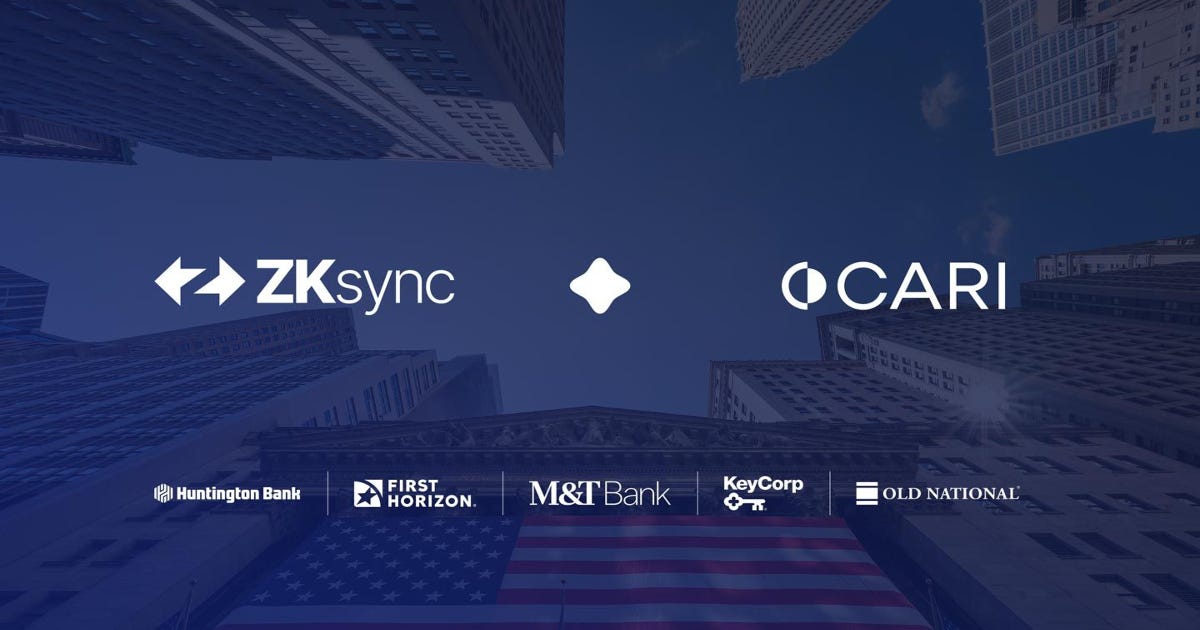
A few weeks ago, multiple major U.S. regional banks announced the CARI Network, a consortium for tokenized deposits built on ZKsync's Prividium, a permissioned Ethereum Layer-2. The five founding members collectively hold nearly $780 billion in assets, and the initiative is led by Gene Ludwig, a former U.S. Comptroller of the Currency.
What are tokenized deposits?
Unlike stablecoins, which are issued by non-bank entities and backed by reserves, tokenized deposits are digital representations of cash that sit directly on a bank’s balance sheet. They remain direct liabilities of the issuing bank, fully integrated with existing banking systems and regulatory frameworks. In practical terms, a tokenized deposit on the CARI Network functions like a regular bank deposit. It is insured, regulated, and backed by the bank. But it moves on blockchain infrastructure with the speed and programmability that entails.
How does the CARI Network work?
What makes the CARI model distinctive is its shared token architecture. Rather than each bank issuing its own distinct tokenized deposit, all five institutions share a single interoperable token. A Huntington customer and a KeyBank customer holding CARI tokens hold the same token, making peer-to-peer and business-to-business transfers seamless regardless of which bank each party uses.
The underlying technology, ZKsync’s Prividium, is a private, permissioned Layer-2 network anchored to Ethereum. The system inherits Ethereum’s security and settlement guarantees while maintaining the privacy and access controls that regulated financial institutions require.
Why does it matter?
The CARI Network is significant on multiple levels.
First, it represents one of the clearest signals yet that U.S. banks are moving from exploratory blockchain pilots to production infrastructure. These are major regional institutions with nearly $800 billion in combined assets, building a shared ledger they intend to operate commercially by year-end.
Second, the consortium model is explicitly designed to compete with stablecoins. As stablecoin adoption grows, and as the CLARITY Act debate sharpens the question of how digital dollars should be regulated (more on that later), banks are positioning tokenized deposits as the regulated alternative: same speed, similar programmability, but with deposit insurance and bank-grade compliance. This for example stands in contrast to Qivalis, the first European consortium working together on a EUR stablecoin that includes players such as BNP Paribas, ING, and Deka.
Third, the choice of infrastructure is telling. Building on a permissioned Ethereum Layer-2, rather than a fully proprietary or private chain, signals a pragmatic convergence between traditional banking and public blockchain technology. The banks have chosen to build on top of crypto-native infrastructure and adapt it to their regulatory reality.
The question now is whether the consortium model, and the network effects it promises, can scale quickly enough to compete with the growing stablecoin ecosystem. The commercial rollout in Q4 2026 will be the first real test.
The White House Makes Its Case for Stablecoin Yield and the CLARITY Act
Last week, the White House Council of Economic Advisers (CEA) released a 21-page report arguing that banning yield on stablecoins would do little to support bank lending while imposing measurable costs on consumers. The same day, Treasury Secretary Scott Bessent published a Wall Street Journal op-ed pushing Senate Republicans to advance the CLARITY Act, the comprehensive digital asset market structure bill that has become the administration's top legislative priority in the space.
What did the CEA report find?
The report, calibrated using Federal Reserve and FDIC data on deposits, lending, and bank liquidity, challenged the banking industry’s core argument against stablecoin yield. Banks have warned that if stablecoins offer competitive returns, deposits would shift out of the traditional system, reducing lending capacity, particularly at smaller community banks.
The CEA’s findings undercut that argument directly:
Minimal lending impact: Banning stablecoin yield would increase bank lending by approximately $2.1 billion, just 0.02% of total bank loans.
Significant consumer cost: The ban would cost consumers an estimated $800 million, implying a cost-benefit ratio of 6.6. In other words, the cost to consumers would be more than six times the benefit to bank lending.
Reserve recycling: Most stablecoin reserves are parked in Treasuries that cycle back into the banking system anyway, limiting the net impact on deposit availability.
Why is the White House pushing so hard?
The CLARITY Act is the legislation that would establish a comprehensive regulatory framework for digital assets in the U.S. It would grant the CFTC exclusive jurisdiction over digital commodity spot markets while maintaining SEC authority over investment contract assets. For the industry, it represents the most significant potential regulatory milestone in years: clear rules of the road that would unlock institutional participation at scale.
The stablecoin yield question has been the primary political obstacle. The GENIUS Act, a narrower stablecoin-focused bill, bans issuers from paying interest directly but leaves open a workaround via intermediaries. Banks have lobbied to close that workaround in the CLARITY Act, warning of deposit flight. The White House report is a direct response to that lobbying effort.
Where does this leave us?
On Polymarket, the CLARITY Act currently has a ~47% chance of passing this year. Failure to advance it out of committee before May could severely imperil its prospects before the November 2026 midterms. The clock is ticking.
Blockwall Portfolio Update
Following the Spiko update above, we are excited to share that our portfolio company Kulipa recently announced its $6.2 million seed round, co-led by Flourish Ventures and 1kx, with participation from White Star Capital, Fabric Ventures, and Blockwall. We committed to the round last year and are glad to see it come together with such a strong group of co-investors. The round brings Kulipa’s total funding to $9.2 million.
Kulipa builds the infrastructure that lets fintechs and crypto wallets issue white-label stablecoin payment cards. In simple terms, Kulipa handles all the complexity behind the scenes, from payment processing and fraud management to settlement and compliance, so that wallet providers can offer their users a card that spends stablecoins at any merchant terminal, online checkout, or via Apple Pay and Google Pay. Since launching its infrastructure in early 2025, Kulipa has issued over 120,000 cards across 20 customers.
We are proud to support Kulipa in their mission to bridge the gap between self-custody wallets and everyday payments. As stablecoins become a core settlement layer, making them spendable at the point of sale is an essential piece of the puzzle. For our full investment thesis on Kulipa and the future of direct digital payments, see our post here.
Key Events of the Last Few Weeks
Mastercard acquires BVNK for $1.8 billion. The payments giant purchased the stablecoin infrastructure company that helps businesses connect traditional banking rails with blockchain networks. The deal follows a failed attempt to acquire Zerohash a few months earlier and signals how strategically important stablecoin infrastructure has become for incumbent payment networks. (Source: Mastercard)
Credit Agricole prepares euro stablecoin launch. Europe’s second-largest banking group, managing €2.4 trillion in assets, is reportedly structuring a euro-denominated stablecoin with a launch expected this summer. (Source: Blockstories)
Tether signs Big Four firm for audit. The engagement would mark the first full independent financial audit for the world’s largest stablecoin issuer, a milestone the industry has been waiting on for years. (Source: Tether)
BNP Paribas now offers crypto ETPs. French clients of Europe’s largest bank can now invest, through their brokerage accounts, in six ETNs tracking the price of Bitcoin and Ether. (Source: BNP)
SoFi launches Big Business Banking. The new offering enables enterprise partners to manage both fiat and crypto banking through a single nationally chartered bank. SoFi serves 13.7 million members and holds over $50 billion in assets. Initial participants include firms like Cumberland, Fireblocks, Galaxy, and Mastercard. (Source: Businesswire)
Bitpanda launches Vision Chain. The Layer-2 network provides banks and fintechs with infrastructure to issue and settle tokenized assets under EU frameworks such as MiCA and MiFID II. Interestingly, transaction fees are paid in regulated EUR stablecoins. (Source: Bitpanda)
Ramp introduces Stablecoin Accounts. Customers of one of the fastest-growing money operations platforms can now hold stablecoins, earn rewards on their balances, and pay vendors and employees worldwide. The feature remains in public beta. (Source: Ramp)
What We’ve Been Reading
The Liquidity Illusion: Private Credit’s Reckoning and the On-Chain Answer (Blockwall) — A deep dive into the structural flaws of private credit funds exposed by BlackRock’s HLEND withdrawal cap and the MFS collateral fraud, and why blockchain infrastructure is the answer. For the full analysis, see the Blockwall Insights Substack.
Beyond Dollarization: The Rise of Local Currency Stablecoins (Dune x Visa) — While USD stablecoins dominate the headlines, a second wave of local currency stablecoins is quietly gaining traction. This report maps the on-chain data behind non-USD stablecoins across payments, FX, treasury, and DeFi, covering EUR, BRL, JPY, and SGD. For the core insights, see Dominic's LinkedIn post.
Agentic Finance and Stablecoins (Dynamic / Fireblocks) — A great overview of the emerging agentic payments landscape, its current state of adoption, and how crypto fits into the underlying technology stack.
Disclaimer
To avoid any misinterpretation, nothing in this blog should be considered as an offer to sell or a solicitation of interest to purchase any securities advised by Blockwall, its affiliates or its representatives. Under no circumstances should anything herein be interpreted as fund marketing materials for prospective investors considering an investment in any Blockwall fund. None of the data and information constitutes general or personalized investment advice and only represents the personal opinion of the author. The author and/or Blockwall may directly or indirectly be exposed to the mentioned assets/investments. For further information please view the full Disclaimer by clicking the button below.
This work is licensed under the Creative Commons Attribution – No Derivatives 4.0 International License. CC BY-ND 4.0 Legal Code | Creative Commons