

Dear Founders, Investors, and Friends,
It’s great to have you back for the October 2026 edition of Blockwall Insights. Here’s what we’re covering today:
Spiko’s SAFO Becomes the World’s Largest Tokenized Fund
Blink Labs Joins Gattaca
ICE and Trade[XYZ] Bring Hyperliquid Closer to US Markets
Blockwall’s Investor Summit 2026
Key Events of the Last Few Weeks
What We’ve Been Reading
Executive Summary
Spiko’s SAFO became the world’s largest tokenized fund in October, seven months after launch. Spiko also raised a $90 million Series B led by NEA.
Blink Labs was acquired by Gattaca, marking an exit for Blockwall. Blink’s transaction infrastructure will join Gattaca’s Titan Builder.
ICE and Trade[XYZ] plan to bring Hyperliquid-based perpetual markets to the US. Veteran macro investor Stan Druckenmiller confirmed his investment in Trade[XYZ].
Again this year, we hosted our annual Investor Summit in Frankfurt, bringing together investors, founders and industry leaders to discuss 24/7 markets, stablecoin payments, onchain credit and the infrastructure AI agents need to transact.
Blockwall Portfolio Update
Spiko’s SAFO Becomes the World’s Largest Tokenized Fund
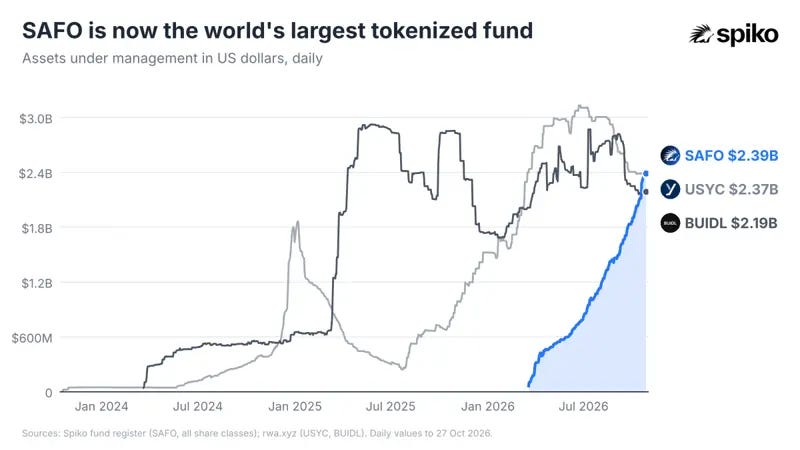
In March, our portfolio company Spiko and Amundi launched the Spiko Amundi Overnight Swap Fund (SAFO). In October, Spiko raised a $90 million Series B led by NEA. A few weeks later, SAFO became the largest tokenized fund in the world.
Seven months from launch to the top. Let that sink in.
On 27 October, SAFO held $2.39 billion, ahead of Circle’s USYC at $2.37 billion and BlackRock’s BUIDL at $2.19 billion. USYC launched in 2023 and BUIDL in 2024, giving both a head start. SAFO caught up in seven months.
To put that pace into perspective: seven months after launch, SAFO held $2.28 billion. At the same age, BUIDL held $551 million. SAFO had grown to more than four times its size at that point. The growth indicates the substantial demand for regulated tokenized cash management funds.
Spiko 101: Cash Management and Access
Spiko’s treasury platform provides access to regulated cash management funds designed to earn yield on cash, with digital subscriptions and redemptions. Eligible euro withdrawals can be made instantly, including outside banking hours. Alongside SAFO, its products include Treasury bill money market funds and the Spiko Cash & Carry Fund.
Businesses, funds and family offices can access Spiko through its online platform. Spiko also offers APIs that allow clients to connect their accounts to existing systems and financial platforms to integrate its funds into their own products.
Spiko’s mobile app is available for individuals and businesses on iOS and Android. It supports deposits and withdrawals, team transaction approvals and two-factor authentication. More than 4,000 customers were using it when Spiko announced the app on 28 October.

SAFO: Product and Adoption
SAFO is a regulated UCITS fund launched by Spiko, with Amundi acting as delegated investment manager. Through a fully collateralized swap with BNP Paribas, it aims to deliver an overnight reference rate plus a spread. Spiko provides the infrastructure, with fund shares recorded onchain. Here is how SAFO works.
SAFO: Key Figures
By late October, more than 5,000 businesses held SAFO, accounting for nearly 90% of its assets. The median business position was around $60,000. The fund is available to eligible businesses and individuals from one euro, dollar, pound or Swiss franc, either through Spiko or through partners using its infrastructure. More than 80% of SAFO was held through direct Spiko accounts.
Around 60% of business holders have less than $100,000 invested and together hold about 5% of the fund. More than 300 businesses hold at least $1 million each; those larger positions account for nearly two thirds of SAFO’s assets.
SAFO has also brought new customers to the platform: more than three quarters of the businesses holding it were not previously Spiko clients. At the same time, nearly $900 million was switched into SAFO from other Spiko funds.
By late October, around 85% of the assets across Spiko’s funds came from France. Spiko has reached this scale largely in its home market while expanding across Europe.
Why Blockchain? Paul-Adrien’s Perspective

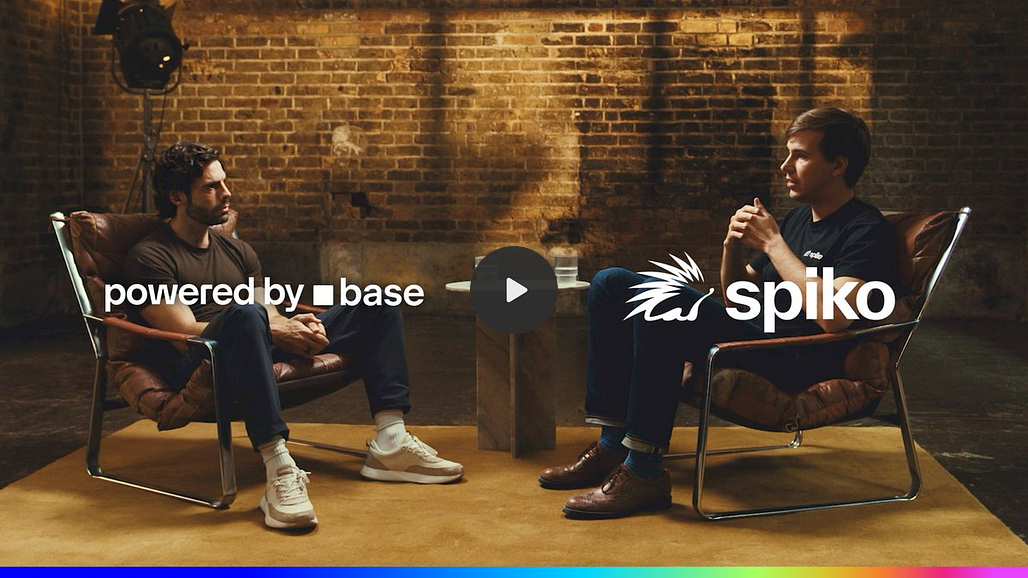
In his conversation with Base, Spiko co-founder and CEO Paul-Adrien Hyppolite explains why the company chose public blockchains. They provide fast, low-cost infrastructure on which tokenized cash and financial instruments can exist on the same global network. The network operates around the clock and provides transparency into onchain activity, an aspect Paul-Adrien highlights for CFOs and treasury teams.
When we first invested in Spiko, we believed that putting regulated fund shares onchain could make them easier to access and distribute.
For a company managing cash, access matters as much as yield. Since launch, SAFO investors have made more than 11,000 instant withdrawals, paid in a median of around 40 seconds. 44% were made outside banking hours, including evenings, nights and weekends.
Eligible euro withdrawals can be made instantly, including outside banking hours. Other withdrawals follow the fund’s regular redemption cycle.
Blink Labs Joins Gattaca

This October, our PortCo Blink Labs was acquired by Gattaca, marking an exit for Blockwall. Our Principal Syed Armani backed founders Yaniv Neu-Ner and Ciaran McVeigh at pre-seed in 2023, when he saw the opportunity to improve how blockchain transactions are routed and protected. Read more about why Blockwall invested in Blink.
Since then, Blink has grown into a key transaction infrastructure provider for wallets and applications. Today, Blink has processed more than 4 billion transactions and handles over 15 million transactions per day across multiple blockchains. Blink integrates protection against harmful maximal extractable value (MEV) into wallets and applications. It works in the background, without requiring users to change their behaviour. MEV is value extracted by including or reordering transactions in a block. A sandwich attack is one example: trades placed before and after a user’s transaction can leave them with a worse price.
Gattaca runs Titan Builder, which orders transactions and builds around half of Ethereum’s blocks. Together, the two companies bring the point where a transaction starts closer to the infrastructure that executes it.
We are proud to have supported the team on this journey and congratulate Yaniv, Ciaran and everyone at Blink on this milestone.
Market Update
ICE and Trade[XYZ] Bring Hyperliquid Closer to US Markets
In October, Intercontinental Exchange (ICE), the owner of the New York Stock Exchange, announced an agreement with Trade[XYZ] to bring Hyperliquid-based perpetual markets into a regulated US framework.
ICE is investing in Trade[XYZ] and plans to set up a dedicated market and clearing structure. The plans still need regulatory approval. On top of that, Stan Druckenmiller, one of the most respected macro investors in traditional finance, confirmed that he’s an investor in Trade[XYZ]. He also said he looks forward to using the product as an investor. For us, his backing is a sign that 24/7 markets for assets like gold, oil and equities are becoming relevant to macro investors. They offer a way to react to events even when traditional markets are closed.
Trade[XYZ] was already seeing strong growth before the announcement. In just over a year, its existing Hyperliquid markets surpassed $650 billion in cumulative trading volume. Over the 12 months from November 2025 to October 2026, its markets generated approximately $71.2 million in trading fees, of which $27.2 million was retained by Trade[XYZ] as protocol revenue.
What Are Perps aka Perpetual Futures?
A perp gives traders exposure to an asset’s price without an expiry date. Funding payments between long and short positions help keep the contract aligned with its reference price. A stock perp provides price exposure, but does not give its holder shares or voting rights. Margin, funding costs and liquidation risk also need to be managed. The idea of perpetual futures was proposed by economist Robert Shiller in the 1990s. In 2016, BitMEX, co-founded by Arthur Hayes, launched the crypto perpetual swap, which became a widely traded product in crypto markets.
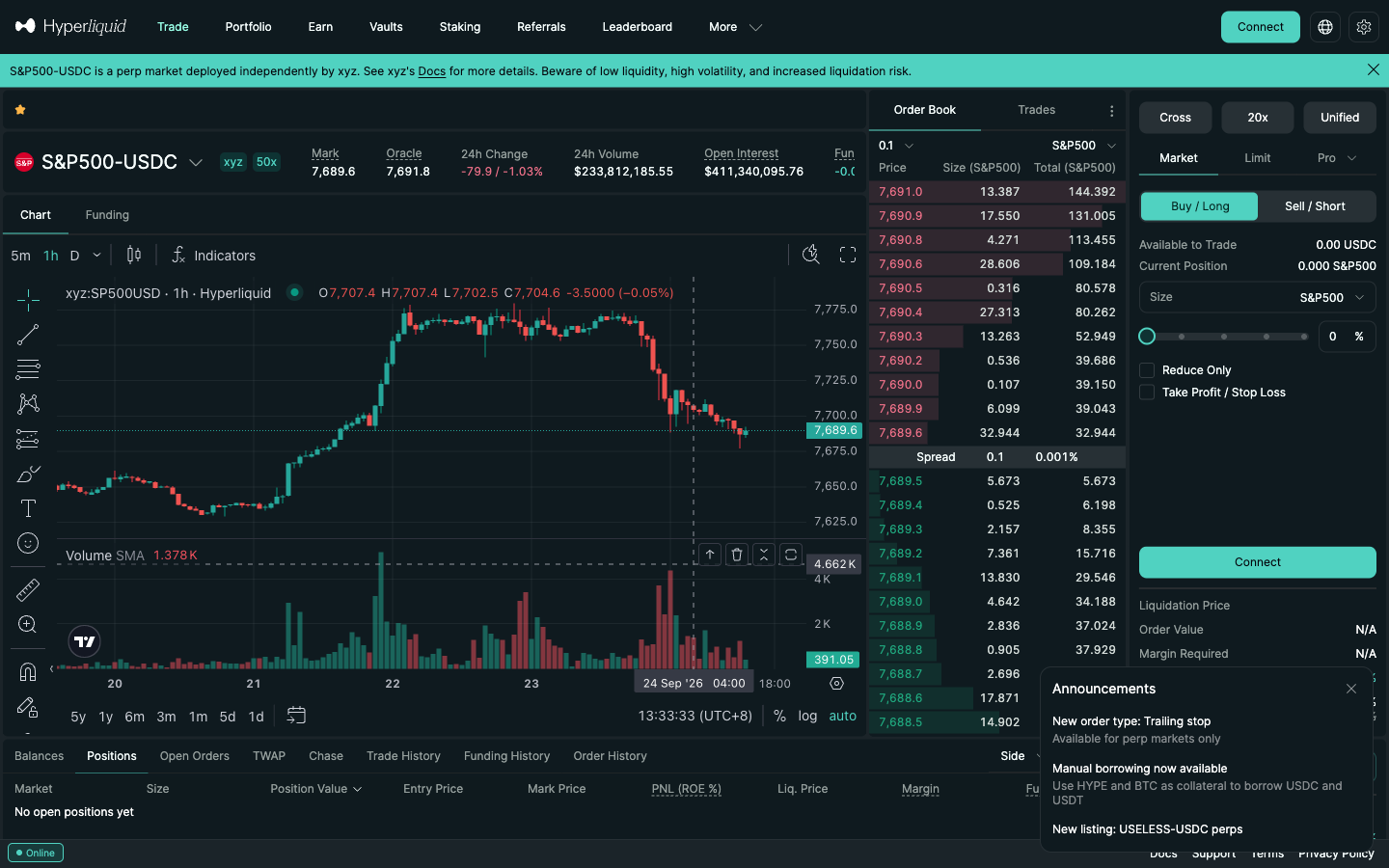
For traders, the appeal is the ability to express a view when a traditional reference market is closed. A geopolitical announcement over the weekend, for example, can be reflected in a perp market without waiting for the next regular session. Those prices still depend on liquidity and the quality of the reference data available at the time. Below: Trade[XYZ]’s S&P 500 perp on Hyperliquid.
From Trading Venue to Infrastructure for Builders
Hyperliquid started with crypto perpetuals. Its HIP-3 framework allows external teams to deploy and operate their own perp markets on its trading infrastructure. Trade[XYZ] is one example, with markets referencing equities, commodities, currencies and indices.
For us, this is where the story becomes very interesting. Founders can build markets and applications around an existing trading system instead of building an exchange from scratch. Their businesses can differentiate through the markets they choose, reliable pricing, liquidity and the way they reach customers. Shared infrastructure does not automatically create shared liquidity: each market still needs participants willing to trade.
Why Capital Efficiency Matters
Another part of the opportunity is how collateral can be used across positions. Hyperliquid’s portfolio margin brings eligible spot holdings and cross-margin perpetual positions together in one account. A trader holding BTC, for example, can use that position to support a BTC perp short, rather than keeping separate collateral for each leg. The same idea could extend to tokenized assets such as precious metals: if tokenized gold becomes eligible as collateral, an investor could keep holding gold while using it to support a short position in a silver perp. That can reduce the capital tied up in managing a hedge.
What started with crypto perpetuals is now reaching markets that macro investors have traded for decades. The assets may be familiar, but the infrastructure around them is changing: markets can run around the clock, and collateral can be used across positions in the same account.
Blockwall’s Investor Summit 2026
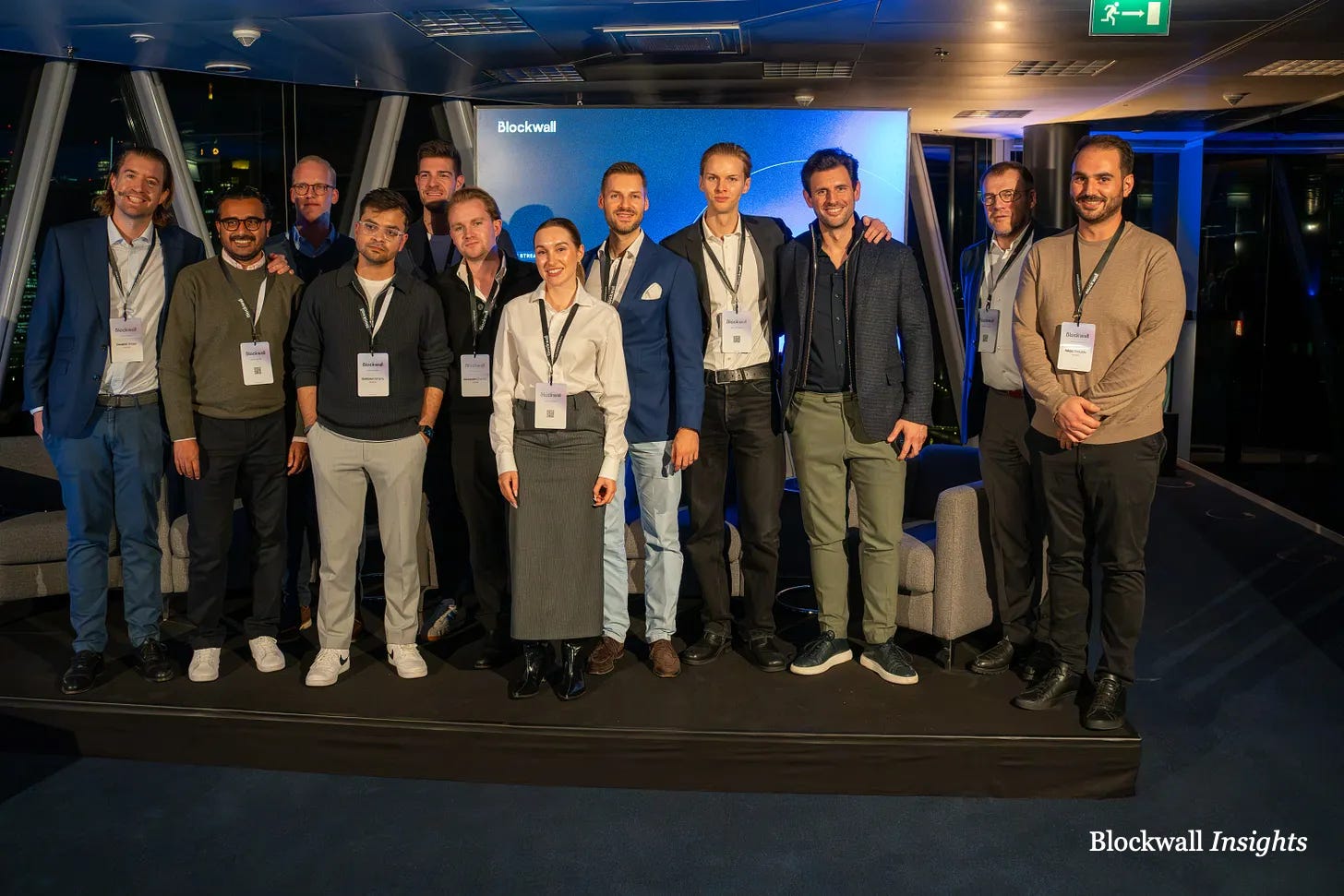
On 29 October, we welcomed investors, founders and industry colleagues back to Frankfurt for our Investor Summit 2026.
Throughout the day, our speakers discussed a question at the heart of our investment thesis: what will the economic layer of the internet look like?
24/7 markets and prediction markets can give investors ways to trade specific outcomes, but need deep liquidity and reliable execution.
Stablecoins already help businesses make cross-border payments. Nilos showed how its infrastructure connects African payment systems with international payouts.
Onchain credit can connect borrowers and investors through tokenized receivables and automated payment flows, as Tranched illustrated. Legal requirements and smart-contract security remain part of implementation.
As AI agents take on economic tasks, they need reliable context, access to compute and proof of who they are acting for. The discussion with Kirha and Nebius showed that these questions are still being worked through.
We closed the day with J. Christopher Giancarlo, former Chairman of the U.S. Commodity Futures Trading Commission (CFTC) and Chairman of Polymarket’s advisory board, on financial freedom in the 21st century.
Thank you to our amazing speakers: Joe Schorge, Michael F. Spitz, Cameron Loo, Philipp Zentner, Michael Adeyeri, Clément Larrue, David Durouchoux, Raphael Fettaya, Ernst-Cornelius Koch, Leon Marshall, Ritu Soni, Dr. Carsten Stöcker, Pierre Hay, Ulysse Laroche and J. Christopher Giancarlo.
This day would not have been possible without the amazing Blockwall team. We all look forward to continuing the conversation with each and everyone.
For those who could not join us, the panels will be available soon on our YouTube channel.
Key Events of the Last Few Weeks
Binance reports $6.34 billion security incident. Binance disclosed a breach affecting approximately $6.34 billion in digital assets. By 5 November, $2.85 billion was frozen and around $3.35 billion remained in addresses linked to the theft. Separately, Binance said it had replenished around 98% of the affected assets using its own funds as of 4 November. Withdrawals for more assets resumed on 5 November.
a16z Crypto becomes a16z Frontier. Andreessen Horowitz renamed its crypto investment arm a16z Frontier, broadening the scope of its new fund to frontier technologies including AI and autonomous machines. The team will continue investing in crypto. Dixon points to the blurring lines between crypto and other technologies.
Kalshi raises $1 billion at a $40 billion valuation. The prediction market platform raised a Series G led by Sequoia and Wellington.
Ledger devices tampered with in supply chain attack. Ledger confirmed an unauthorized hardware implant in a device sold through reseller CryptoBilis. Galaxy Research estimates that around $91 million was stolen from 474 addresses. The implant captured recovery phrases from the device screen and transmitted them over a mobile network.
Mastercard and BVNK launch Global Money Platform. The platform brings together fiat and stablecoin capabilities for payments, conversions and treasury through a single API.
What We’ve Been Reading
Breaking The Wall - Citrini Research
Citrini argues that AI agents could continuously move cash towards higher yields, challenging banks’ deposit funding. It sees tokenized assets and always-on financial infrastructure as a foundation for agent-driven finance. Note: PaywallState of Tokenization - Pantera Capital
In Pantera’s sample of 110 non-stablecoin products, open-access assets accounted for 41% of value but 99.8% of observed spot trading in June. Low spot volume does not necessarily mean investors cannot exit: some funds offer redemptions through the issuer.Compute Capital Markets - Multicoin Capital
Multicoin argues that compute markets need to start with physical delivery because GPU capacity varies too much for a single futures price to reliably hedge buyers’ needs. Verified claims on capacity could then support financing and serve as collateral.The Always-On Dollar - Coinbase and The Block
Stablecoins moved more than $400 million per hour on average in adjusted transfer volume in Q3 2026. Over the 12 months to July, 73% of screened transfer volume occurred outside US banking hours.The Behavior of Polymarket Traders - Galaxy Research
Of 2.9 million accounts classified as retail on Polymarket’s international platform, 69.2% were below break-even, with an aggregate loss of $338.9 million. The analysis counts wallet addresses, not necessarily individual traders.Conditional Markets Are Beginning to Blossom - Galaxy Research
Decision markets govern $50.5 million across 24 DAO treasuries, using market prices to inform binding decisions. Impact markets use a similar mechanism to price how an event could affect an asset, but liquidity is still developing.
Thanks for reading Blockwall Insights! Subscribe for free to receive new posts and support our work.
Disclaimer
To avoid any misinterpretation, nothing in this blog should be considered as an offer to sell or a solicitation of interest to purchase any securities advised by Blockwall, its affiliates or its representatives. Under no circumstances should anything herein be interpreted as fund marketing materials for prospective investors considering an investment in any Blockwall fund. None of the data and information constitutes general or personalized investment advice and only represents the personal opinion of the author. The author and/or Blockwall may directly or indirectly be exposed to the mentioned assets/investments. For further information please view the full Disclaimer by clicking the button below.
This work is licensed under the Creative Commons Attribution – No Derivatives 4.0 International License. CC BY-ND 4.0 Legal Code | Creative Commons
Given your VC work at Blockwall, do you come across portfolio companies exploring financial infrastructure or cross-border payment solutions?